'Louis' kindly left this comment on my post a day or two ago:
'In case you have some friends coming to Asia in the near future, this is
just to let you know that Cacho Dante will be coming to Hong Kong,
Seoul and Singapore during October-November. I understand that this will
be the first time he is coming to Asia. This was made possible thanks
to my good friends in Hong Kong.'
The post is a year old now, a year old to the day, as it happens, so I thought I should drag the comment out into the open in case anyone is in Asia, or thinking of going there.
I took Cacho's classes a couple of years ago. I found him very disciplined and methodical in his teaching: he also takes trouble to observe everyone very carefully, and advise them on walk and posture. The stories he tells on his website suggest a lively, fun-loving guy, but he takes his tango teaching very seriously, and the classes are concentrated, hard work even, and an excellent preparation for long milonga nights. I've seen young portenos from those classes dancing in the milongas, and I thought they looked good. Tango teaching in classes is something new, but I believe that Cacho, balancing exercises with social dance with teaching sequences, has got it right. It's all in the approach: he's not teaching you to show off, he's teaching you to dance well, and he expects you to take him, and tango, seriously. Very, very welcome. The 'good friends in Hong Kong' who invited him are to be emulated!
His website has been updated and now has links to his YouTube videos, and photos of Cacho with his students around the world.
PS. Here is the blog page with dates from the organisers of the tour.
Wednesday, 22 August 2012

Thursday, 16 August 2012
'El Flaco' Dany and Lucia Mirzan
So
the tide has come in again. I may well be – I hope I am – the
last person in Europe to catch up with these videos. They've been
around for up to eight months, with many viewings. I hope I'm the
last person to see them just because I hope everyone else has already
enjoyed them.
It's
such a beautiful, imaginative idea, to take El Flaco Dany to ten
cities, film a brief class with him, talk to him about orquestas and
dancers, and then a brief reaction to the city. The first city is
Bucharest, and after showing a short milonga sequence and explaining it,
he sits down with Lucia Mirzan and remembers the D'Arienzo orquesta
and its performances. He then talks about a dancer he knew – Gavito
– and then his observations on the local Romanian music, which
impressed him. To date, there are three other videos covering the
orquestas of Troilo, Pugliese, and Di Sarli, three singers, and the
dancers Juan Carlos Copes, Osvaldo Zotto, and 'Puppy' Castello and
their partners. Some well-chosen clips of these orquestas and dancers
fill out the picture. The cities so far have been Tel Aviv, Frankfurt
and Istanbul, and I assume that London will be among the other six
videos still to appear, since El Flaco and Lucia were there recently.
I look forward to these relaxed and informal conversations about
music and dance, and to El Flaco's stories. The subtitles are in excellent
English and seem to be accurate. It's a wonderful project.
Of the classes, the blog says that they present '...the basis of Flaco Dany’s milonga technique, as a reference in finding your own milonga style.' I particularly like that phrase 'as a reference'. This is material to be used as needed, not merely copied. (Well, as if anyone could copy El Flaco...)
The
videos are on YouTube, but are collected on this page of the
Flacodany blog.
Sunday, 5 August 2012
Todaro
Internet
searches are a bit like the tide: you never know what's going to turn
up amidst a mound of flotsam and jetsam, and YouTube recommendations are similar. Amidst a recent list of videos that YouTube
thought might appeal to me I found genavel1's channel, which includes
a whole archive of films of the 'Todaro era', of Antonio
Todaro (1929-1994) and his followers.
The
film of Todaro and his nine year-old daughter Títi has been on
YouTube for a while, and this archive also includes him dancing with
her aged perhaps around 13 or 14. The films are undated, but the
dates of Todaro and his daughter would suggest that some of the
filming goes back to the 1960s; many of the women are wearing short
skirts (which may not altogether suit them). The locations look
'underground', barely decorated except for posters on the walls, but
the lighting is very poor. & either the filming was silent or the
recorded sound was so poor that the sound we hear was added later, so
what we hear isn't necessarily the music the couples are dancing to.
& I assume it was film: 8mm or Super8. Home movies! The dancers include Todaro, 'Petroleo', Raúl
Bravo, Miguel Balmaceda y Nely. 'El
Famoso Arturito, inventor de milonga traspie' is also there (ever
heard of him?) The
more recent clips have recorded sound, and these may be from the
1980s/1990s, and include 'Puppy' Castello dancing with Graciela
Gonzalez.
A
random look at the clips shows a familiar enough dance. What
fascinates me about the dancing in these clips is the extent to which the women are empowered:
their energy and input and determination equal that of their male
partners. It really is a 'no holds barred' dance. It must have been
fairly revolutionary and, like the short skirts, suggests profound
changes in Argentine society since the early 1930s. It's not stage
tango; it's too lively and disorganised for that, although a lot of
skill and practice has gone into it. Nevertheless, I assume that
stage tango is a refined version of it, replacing the audacious joyful fun
of the original with a simulacrum of bored passion and sophistication. Despite the poor
lighting, there's a real sense of enthusiasm, and people having fun
dancing. Which doesn't mean I'd want to be anywhere near them on a
crowded floor!
It's
not the dance of contemporary milongas, which have gone in a
different emotional direction. The affectionate embrace of milongas
today is one of the great attractions of tango to many of us, and you
don't see that in these clips. At the same time, this is part of the
background to contemporary Buenos Aires tango. Many of the older
dancers didn't go near Todaro and his academia, but others did, and
this kind of tango would have been seen around, and I think everyone
would have been aware of it. Tango and Chaos has a piece on Todaro
that seems to sum it up very clearly. He doesn't actually say that
Celia Blanco, who runs that most
'traditional' of milongas, Lo
de Celia, was Todaro's student, but I'm sure I've read that she was: I wonder if that's her in the picture.
Todaro might not be an obvious influence on the dance of contemporary
milongas, but I'd assume he's there, and he's certainly there in the dance of
dancers like Geraldine and Javier, and a host of alikes. To dance his
tango requires ability, and a lot of practice, as well as a certain
desire to show off. Innocent fun when you have space, and all your
friends encouraging you, although many of us have other preferences.
I
can't help wondering what happened to 'Títi', Todaro's hyperactive
beanstalk of a daughter. I guess she'd be in her 60s now. Hard to
think that she'd have turned her back on tango.
PS: The clip of Todaro and his nine year-old daughter is on Babaz's channel, which I see also has this clip -- of Charlie Chaplin dancing tango. Hilarious, and much too short.
PS: The clip of Todaro and his nine year-old daughter is on Babaz's channel, which I see also has this clip -- of Charlie Chaplin dancing tango. Hilarious, and much too short.

Saturday, 28 July 2012
El Beso
Jantango made this comment to my post on El Beso:
'2xtango.com posted the announcement on July 26 that El Beso will reopen in August. No specific date was mentioned. All the milongas are returning home.'
-- which is good news. Being somewhat sceptical I'd assumed that a relatively undeveloped property, only two floors in a city increasingly of high-rises, at the central intersection of two major thoroughfares, was probably the subject of real estate negotiations for humongous sums of US dollars. I'm happy to be wrong, but I'm curious about the return of all the milongas. Maybe larger, less crowded floors aren't so attractive, or maybe they are just more expensive. Maybe the expansion of dancing over the last decade or two has levelled off, and larger floors simply aren't needed or economical. Or maybe there's a concensus that this intimate dance is more at home in small venues where people are closer, both on and off the floor. Cachirulo successfully managed the move from Maipu 444 (small) to Villa Macolm (large), but maybe the event becomes more impersonal with a lot more people. I'm in no doubt which of the two venues I prefer, and it's certainly not the larger one.
'2xtango.com posted the announcement on July 26 that El Beso will reopen in August. No specific date was mentioned. All the milongas are returning home.'
-- which is good news. Being somewhat sceptical I'd assumed that a relatively undeveloped property, only two floors in a city increasingly of high-rises, at the central intersection of two major thoroughfares, was probably the subject of real estate negotiations for humongous sums of US dollars. I'm happy to be wrong, but I'm curious about the return of all the milongas. Maybe larger, less crowded floors aren't so attractive, or maybe they are just more expensive. Maybe the expansion of dancing over the last decade or two has levelled off, and larger floors simply aren't needed or economical. Or maybe there's a concensus that this intimate dance is more at home in small venues where people are closer, both on and off the floor. Cachirulo successfully managed the move from Maipu 444 (small) to Villa Macolm (large), but maybe the event becomes more impersonal with a lot more people. I'm in no doubt which of the two venues I prefer, and it's certainly not the larger one.
Monday, 23 July 2012
The West-Eastern Divan Orchestra
I
guess we all have a sense of who we think of as the greatest living
human, and Nelson Mandela must be at the top of most people's lists.
I can't argue with that, but Daniel Barenboim comes extremely close for me.
He's one of the world's finest concert and recital pianists, he's also general
music director of La Scala in Milan, and of the Berlin State Opera.
He
also argues passionately for Palestinian rights, and has been called
a 'true anti-semite' by bewildered Israeli politicians. With the late Edward
Said he set up the West-Eastern Divan Orchestra of Palestinian and
Jewish youths playing music together, which he directs (in addition
to all his other careers). It's wonderful that the BBC invited the
orchestra and Barenboim to perform at this year's proms – and
to perform all nine Beethoven symphonies, the entire cycle, two each night
this week, with the ninth on Friday coinciding with the opening of
the Olympics. It's an extraordinary accolade.
I'm
pretty sure I saw the orchestra from the top of a bus this morning, a
large group of cheerful-looking young people with instruments in cases
outside the old Commonwealth Institute, obviously waiting for a
coach to take them somewhere, presumably to the Royal Albert Hall to
rehearse Beethoven's fifth. What a week for them! I heard part of the broadcast this
evening: it sounds like a smaller orchestra than any of the great
Philharmonics, but the equal of all of them for intensity, enthusiasm and
commitment. It sounded great.
Barenboim was born in Buenos Aires and tango was some of the first music he heard. He records
that it was his parents' music when they relaxed and went out dancing,
the songs they sang at home.
Monday, 16 July 2012
Nightmare on the streets of Buenos Aires
I
awake from a nightmare on the streets of Buenos Aires. I've arrived
back in the city, and it seems to be a future time. There's some kind
of revivalist milonguero festival on, and everyone is concentrating
on Estilo Milonguero, as in 'What was the correct Estilo Milonguero way for
the dancers' hands to meet?' I see people arguing about the exact
hold: no no, the guy's left hand used to be like this! Qué
pesadilla! What
a nightmare! As I wake up, perplexed and groaning, I'm thinking; so
where am I going to get a dance tonight?
A
dystopian vision of the future, or was it a sly subconscious comment
on some aspects of the present? I don't want to imagine what Buenos
Aires might be like in 100, 150 years. &... oh no, a dream about
Buenos Aires! The city with the greatest concentration of analysts on
earth! (Or so it's claimed.) What will they make of me?
In
the cold light of morning I think that if the soul goes out of tango
people will stop dancing, and if they want to start dancing again
there's at least an archive of video: between video and the music,
the dance can be re-created. A pity to have no contact with that era
when kids grew up with the dance and later went to milongas where
Troilo and D'Agostino played, it was that much part of their lives,
but you could get by and learn to enjoy the dance and music from
video. You could get by, but 2D video tends to give a rather
weightless impression: if you look hard, and especially if you use
slow motion, you can work out how weight and momentum are used, but you
don't feel it as directly as when you watch live bodies dancing. But at
least the videos will show nothing rigid about the form of the dance,
so there's hope for a hypothetical tangoless future.
I
should say I avoid the 'm' word: I have a strange aversion to the way
it gets used to define and package a particular style (as if there
was a particular style), and an apparently elite, exclusive group of
tangueros. For some reason I've always felt the reality to be a bit
indeterminate, a bit indefinable. Maybe that's just how I'd like it
to be, but sometimes things are safer if they aren't defined too
precisely. So I myself dance... tango. (At least I hope it's
recognisable as tango.) To be more precise, social tango (as against, anti-social tango.) Perhaps even 'tango salon'. I hope there's no such
thing as 'salonero', or would it be 'salonisto'? Never, I hope!
Monday, 9 July 2012
Dancing together, without big decorations
- 'I really like dancing with you but I want to do those big decorations I learned in the class. I never seem to have time to do them...'
- ...said the newcomer. Oh dear...
- I explain tango fantasia, choreographed right down to the decorations, and 'real-world' tango, the social dance of the milongas, improvised and spontaneous because it's on a dance floor with other people. My partner can't see what lies ahead and I can't see her feet; if I have to change direction, she could trip over herself. (I've seen it happen.) Only if we dance at arms' length is it possible for a partner to insert big decorations safely, since we can look down and see all our feet are up to, but if you're looking down your balance isn't great, and you don't look great either, two people dancing at arms length and looking at their feet. It might be fun, but it's hardly elegant, and anyway I should be watching out for the other dancers around us. It's possible to decorate in close embrace dance, but decorations have to be very skilful, small and quick, not huge gestures meant to be applauded from the back stalls of a theatre. Less is definitely more.
- 'So why do we have classes where these big decorations are taught?'
- Well...
- & I want to say: just relax! But it's not so easy just to let go, and anyway, if my lead is clear and confident, then my partner will relax. The partners I regularly dance with know what I'm doing and what I'm probably going to do: unless I'm aware, lead and follow can go on auto-pilot, and the whole thing becomes just faintly boring. I have to make sure I really am leading every movement: no good just sticking my left leg out sideways without leading from the torso to put some energy, compulsion, some weight, into the lead. It's with a newcomer you discover how well you really lead.
- Like many of his generation, the late Tete was a marvellously assured leader: there are stories of how he could take a complete beginner, one who moved clumsily even, and get her through a dance with him. He taught leading by getting you to lead him: if your lead wasn't absolutely clear he would find a way of doing exactly the opposite to what you hoped you were leading. I guess that's how he learned to lead. It was like trying to lead water if you weren't confident and exact.
- Classes can teach you too much to think about, when the essence of dancing is a kind of surrender. Perhaps that's why dance can feel like making love: you just let the flow of pleasure take over. At the same time, the bodies that walk in off the street desiring to dance tango may well need to go through a period of attunement. If there's a shortage of marvellously assured leaders, they might need help with things that ought to be simple, like posture, like walking not only with the beat but also with the flow of the music too. In daily life we can be quite oblivious of our bodies, and when we come to dance our walk is likely to be stiff and awkward. Dance is a great way to become bodily aware, aware of balance and movement, but it takes work. & it takes realising that that work needs to be done. (Unless, that is, you happened to grow up in a porteño family in the 1940s...)
- The newcomer's young adult daughter was with her one evening, just watching, entranced. 'It's so wonderful to see men and women really dancing together' she said. 'I mean, most of the dancing these days...' That actually made me very happy. & I'm happy to say that, yes, the men and women in the room actually were dancing together, perhaps imperfectly by the highest standards, but together. Without big decorations.
Wednesday, 4 July 2012
Photography, dancing and painting
I
bought a film camera recently and it reminded me of my first
camera, a present. My father sat me down and explained
photography, explained the camera, the film, and how it should be
used. I was about 11. But when I think about it I realise that he
didn't teach me how to make photographs. That was something I had to
learn by myself – and am still learning.
You
look at photos, you read about them, you talk to other photo makers
about their photos and yours. Even now, it still feels like an endless process,
as if you take/make photos in order to find out how to make them, how to make them better. (Or
'take' them: the one real mentor I had in photography spoke French,
and she always spoke of 'making' photos.) & if you put everything into it you might end up making photos that can be recognised as yours, and no one elses's.
I
think it may be some kind of category error to assume that teaching
or learning a practical, creative activity like dancing, painting,
photography, is the same process as teaching or learning a theoretical
or factual subject like history. I think very few of us were
encouraged to learn by enquiry: we were passive containers to be
filled with knowledge. So, now, if we want to know something,
immediately we become students, all ears for our all-knowing
teachers. It's a familiar way of learning.
But
approaching photography or dancing this way really doesn't make a lot
of sense. Sure, there's a certain amount of basic stuff you need to
be taught in painting, but you can't solemnly file into a classroom
week after week to be taught to paint: you have to go out and buy
some tubes of colour and make a mess, and keep making a mess until
you start to find something that makes sense to you and others. The
same with tango. You've got to be released into the wild pretty early
on to develop survival skills. A teacher can, and should, explain the
skills you need, and demonstrate what you need to do, but you've got
to go out there and join the community, learn by trial and error. &
hopefully some wise old teachers, sympathetic partners, perhaps,
who've been round the floor more than a few times, will be there to
help you improve your skills and develop your musicality.'No! Put your foot there, not here!' or 'Con el cuerpo!', as Pedro keeps saying; dance with your whole body rather than just with your feet.
There's
a certain amount in tango that does need to be taught in classes of
some kind, whether one-to-one, or in groups, and these days there are
so many people who want to approach tango that group classes are the
most feasible option. But it should be clear from the start that the real learning is done on and around the
floor, preferably in practicas, by trying and by watching. That is
learning, it's an active process, an activity, and it covers a whole area that
simply can't be taught.
As I've mentioned before, there's a real shortage of practicas in London. Chris left a link to a list of Berlin practicas, and as far as I can make out there are at least two every night, more some nights. In many ways I think practicas suit our relatively informal society better than milongas.
Monday, 25 June 2012
Eleanor Powell
Eleanor
Powell (1912 – 1982) grew up as a ballet dancer and gymnast, but
found work hard to get, so she took up tap and became one of the most
successful US tap dancers, starring with Fred Astaire in a couple of
1940s films, like Broadway Melody.
Because she came from the aerial style of ballet and gymnastics, she
found that learning tap wasn't easy, and according to IMDb '...she
learned to tap by wearing army surplus belts with sandbags attached,
to ground herself.'
Well,
a good many Profesors de Tango Argentino also come from a ballet and gymnast
tradition, and even seem to regard it as a recommendation for teaching
tango. Maybe we need to start an international fund to buy them army
surplus belts with sandbags attached, so they too can learn to be grounded,
and leave that aerial style outside the milonga.
PS: Just how athletic she was, just how much she needed those sandbags, might be clear from this, but the action doesn't start until about 1.30. & an incredible sense of timing, too.
PS: Just how athletic she was, just how much she needed those sandbags, might be clear from this, but the action doesn't start until about 1.30. & an incredible sense of timing, too.
Thursday, 21 June 2012
Profesors de Tango Argentino!
Google
threw this site at me while I was looking for something else. Wonderful!
Did you know that with just 450 hours of theoretical and practical
courses in France (and a quick visit to Buenos Aires as well!) YOU
TOO could become a Profesor de Tango Argentino, with a Diploma to
prove it! Sadly, I can't afford it, but I think we should all look
out for those Profesors de Tango Argentino with their Diplomas.
So
we can do a quick 'giro', maybe with the tiniest 'voleo', and then an urgent 'caminata' in the opposite direction...
Seriously,
though, isn't it sad? Worse, it's a scam. Or... well, maybe not.
After all, yes, you could learn some stage choreography in 450 hours,
and you could learn how to pass it on, too. But at the end of 450
hours, could you dance tango! (Technically it's a question and should
have a question mark, but it's a joke, so it has to have an
exclamation mark.)
I'm
pretty sure there are schemes like this in Buenos Aires too. &
it's a terrifying prospect for the future of tango, all those
Profesors with their Diplomas. Hopefully, no one will take them seriously, but you never know.
Thursday, 14 June 2012
The controversy
The
recent arguments on Tango UK about classes have been a source of
entertainment to many of us. This blog was mentioned in flattering terms,
but the reference might have suggested that I agree with the views of
one of the participants, which I don't. I thought of replying, but
Tango UK is intended as a listing and it's been a bit swamped with
controversy recently.
I
don't agree that classes are evil, futile and a waste of money. Not
all classes, anyway. Some no doubt are useless and misleading, and
it's obviously a problem for beginners, who have to come to grips
with a new kind of social dancing, unfamiliar music, and a layer of
hype, as well as the misinformation from TV dancing series. But just
because some of the best social dancers of Buenos Aires, born some
seventy and more years ago, never attended classes, isn't quite proof
that therefore we should avoid classes. From an early age they were passionate about the
music and the dance, they grew up in a tango environment and they've
also had a lifetime of dance, which no doubt explains their dancing,
rather than the fact that they never went to formal classes.
I
realised early on that being taught 'figures' and learning to dance
weren't quite the same thing, although figures can be a starting
point for learning to dance, but no more than a starting point. I went to every class available, simply
because there was always something useful there: in fact that is how
I came across a class with Ricardo Vidort, which gave me an idea of
the tango of Buenos Aires, and that's what I followed. With tango
classes as with anything else it's 'caveat emptor'. There are people
out there who will take your money in return for something that looks
good on the surface, but isn't much use in social dance. & there
are people who'll inspire you with the warmth and openness of tango
and the tango culture, too.
I
found pre-milonga classes useful when I was less certain of myself at
milongas, not so much for what was taught but because that was where
I could find out who I might approach for a dance – and who I knew
I should avoid. There are classes before many of the traditional
milongas in Buenos Aires too, and they are also a good opportunity to
find who might look in your direction when the dancing starts. The
classes there are more likely to be attuned to the social dance of
the milongas: they'll probably begin with simple walking and warm-up
exercises, and give plenty of time to actual dancing. A simple figure
will be taught, often with possible variations, so it's less like a
rigid choreography. These sessions are more like relaxed practicas
than high-powered choreography classes: low-key and enjoyable, they
are a good beginning to an evening, especially if you're a visitor.
Hopefully classes like these will become more common and popular in
the UK.
For
me, one valuable thing came out of the debate: Andrew RYSER
SZYMAÑSKI's recollections. 'I
remember when Susanna Miller & Cacho Dante came to London [1995?]
they caused a furore, ostensibly because they danced so close. They
gave a few classes, not a lot compared to the numbers now being
peddled by a plethora of gurus, local & imported - but they
changed, in a few weeks, the way tango was danced in the UK. Susanna
was no step-merchant, and I can safely say that in one general class
with her I learned more than in 20 with Gavito. Actually she was a
newcomer to tango at the time, but she had the knack of picking
Cacho's brains for all he knew as a seasoned milonguero.'
Wish we
could get Cacho back to London!
PS: ...and, yes, a lot of good sense was talked on all sides, too. There was probably a lot more agreement than was apparent from the war of words, as so often happens!
PS: ...and, yes, a lot of good sense was talked on all sides, too. There was probably a lot more agreement than was apparent from the war of words, as so often happens!
Tuesday, 12 June 2012
Carablanca
Carablanca has another extended evening, with guest DJ La Rubia from Argentina. Dancing 8 - 2.
Sunday, 10 June 2012
Nur Du and Viktor
I've
been looking forward to Nur Du since late last summer when I managed to book just before it sold out.
Pina
Bausch met Tete in Plaza Doriego one Sunday afternoon in 1994, when he would
dance with anyone, and she suddenly found herself dancing Argentine
tango. She decided to include tango in Nur Du, and invited Tete and
his new teaching partner Silvia to Germany in 1995 to teach her company. When the piece was
performed at the Théâtre du Châtelet in Paris, Pina danced with Tete on
stage.
There's
actually only one tango in Nur Du. No doubt she could have watched
social tango for five minutes and remembered enough to teach her
cast, but she respected the dance and invited them to teach it.
Dancers are 'movement junkies' as someone said, and the experience of
tango isn't quite like any other dance, so it extends the vocabulary,
so to speak. & no doubt she knew the stage tango, 'tango
fantasia', pioneered as a stage show by Copes to such acclaim in Europe in the 1980s,
and it must have pleased her to show social tango, 'real world tango'.
Nur Du is made up of moments, the longest perhaps no more than a
few minutes. A succession of moments, poignant, funny, absurd,
breathtaking. In subdued light, a woman dances to a sorrowful blues,
then the lights come up and she wanders around desperately seeking
for the exit as another woman recalls the routines she used to
perform in high school as a cheerleader. The two overlap, comment on
each other. Perhaps then (I can't remember the sequence) a man and a
woman stand on a chair (lots of chairs in Pina Bausch), he holds her
carefully by the hair, she steps forwards off the chair, suspended by
her hair, and is lowered gently to the ground. Perhaps that was followed
by a sequence I remembered from the film: a man, desperate on the
floor, and when his friend returns he flings himself half way across
the stage into his arms. There is no plot, no story-line. So how did something so fragmentary hold
together? There seems to be a very clear control of time, a sculpting
of time (Tarkovsky's phrase), and of emotion too. You suddenly notice
there's been no laughter for a while. There are moments of intense
activity, then subdued intense passages. The perception of time is
manipulated.
But
most of all I thought that the fragments are held together by the dancers
themselves. Pina Bausch said she was not interested in how dancers
moved but by what moved them. You can imagine many very accomplished
dancers being turned away in favour of those that Pina found truly
interesting, and she made work out of their creativity, anxieties, fears, probably their dreams and nightmares. (Picasso is supposed to have said: 'Many people painted apples. But what is interesting about Cezanne's apples is Cezanne's anxieties'.) Her method was to seek out what was interesting in her
dancers, so essentially they are not performing roles dictated by the
choreographer, ('Romeo', 'The Sleeping Beauty', 'the Black Swan'),
they are given the opportunity to be themselves, and at the curtain
call you look on them as people you have met that evening, remarkable
people you were very privileged to spend three hours with.
Nur
Du had a number of dance sequences. I saw another of her long pieces, Viktor, a few evenings earlier. It's also fragmentary and episodic, with less dance in any conventional sense: Viktor is the only
contemporary piece I've seen in which the women wear heels, the men
shoes, throughout. It's quite a dark piece, it seems to
highlight the way men tend to treat women. It also has wonderfully
absurd and comic moments: an auction of live dogs, for instance. Two
live sheep are led on stage at one point, and the first part ends
with a real on-stage mess: earth, sawdust, broken biscuit and a slice
of veal, probably more. (The veal? The dancer in the film who puts
veal into her ballet shoes: that's a sequence from Viktor.) For the most part the dancers aren't dancing in a
conventional sense, they are 'performers'.
There's more obvious dance in Nur
Du; the tango (Mariposita) memorably warm and familiar, but other
sequences, two men staggering around all over the stage holding a heavy table with
one hand and a glass in the other, laughing and shouting: it's not dance as you know it, but it
demands the strength and co-ordination of dancers to do it. Her
performers are frequently put to the extreme, but that's the nature of
dance. In one instant, out of nowhere, a man walks on stage
with a chair and stands by the seat. Then in one extraordinary sideways leap,
he's over the seat, clears the back of the chair, and is
standing at the back of the chair. Blink and you miss it. I still can
hardly believe I saw it. A quick point, something that wakens,
energises, your perception.
Two performances, two standing ovations.
Two performances, two standing ovations.
There's an interesting piece on Pina's work here. It's from the company's website, which also includes a link to the LONDONblog, a day-by-day account of the visit, in English and with photos.
P.S. WARNING: this performance includes smoking. (Notice outside Barbican auditorium.)
P.S. WARNING: this performance includes smoking. (Notice outside Barbican auditorium.)
Tuesday, 5 June 2012
Saturday, 2 June 2012
Three voices
Sitting
at a London milonga with two friends who have recent experience of
Buenos Aires. It wasn't a great night; not a lot of people there and
the dancing looked scrappy, bouncing around like clothes in a washing
machine, to requote another friend's immortal comparison.
'When
we got to Buenos Aires we were really saddened, frustrated, to find
that the tango we learned in London wasn't the tango danced in the
milongas there. What we'd learned was a simulation of tango, taught
by show dancers. We just sat and watched. It was so amazing to watch
those older dancers, how much dance they can fit into the space, how
smoothly they do those endless turns!'
'&
this is what we see when we get back!' We laugh – but it's not
meant dismissively. It's just... what we're watching doesn't really
look like tango! OK, it's tango, but not as we know it.
'The
whole experience is so different. People come here for a fun night
out... They have fun there too, but it's really different.'
'It's
really part of their lives there, it's a real force, tango is a
passion there. They really enjoy it and they are really serious about
it too.'
'& their whole lives, half a century of life in Argentina, are wrapped up in it too. When you dance with an Argentine you really don't know just what experiences you are embracing.'
'Well,
it's not our culture, not our music, but it's great people come here and
enjoy themselves with this music.'
'&
then we met Silvia, and we were really impressed by her. She left us
both feeling pretty down about our tango: she leaves you with the
feeling you have to start all over again. But that's great: that's
what you need.'
'It's
the guys here who need to change, and they are most resistant to
change. We need teachers like Myriam and Silvia here.'
'& Muma.'
'One
problem, there's just so much tango in London; a milonga one week can
be quite different the following week because different people turn
up. There's not so much continuity of community, at least in central
London milongas. Perhaps that's one reason why milongas outside London have a
better reputation; there's more consistency.'
'& now you get teachers who claim to teach 'milonguero' – with
no real connection with the Buenos Aires milongas and the people who
dance in them. They come over here and teach something they call
'estilo milonguero'! Using the name to make money. 'Milonguero' has
become a buzz-word here, and it's really sad we never get anyone in London who really has long experience of the milongas. But they might not be
popular. They'd be speaking an unfamiliar language to many. They'd
want to get people to do basic things, to walk well... people who
already know dozens of giros with lapizes, saccadas and voleos! &
even worse: they'd expect people to really listen to the music and
dance with it.'
'It's
not our culture, not our music. It's becoming part of our culture but
it'll never be our culture like it's the culture, history,
the life story of Buenos Aires. The music speaks to us, but not really the poetry. Tango song and music is everyone's experience
there, even though not so many people dance it.'
'Traditions
renew themselves or they die off, but we shouldn't assume that therefore we can ignore the culture as it is over there today. Ignoring all those years of experience doesn't make sense. It'd be so great to have a flow of visitors here who have lived their lives with the milongas...'
Wednesday, 30 May 2012
Muma with Osvaldo Natucci
Well
worth keeping an eye on Bendtango's channel: there's another video of Muma dancing with Ricardo Vidort that appeared there about a week ago. But
there's also a condensed version of a vals tanda of Muma
dancing with Osvaldo Natucci (in light shirt and hair) at El Beso in 2000, which I keep watching over and over. It
brings it all back! & it's as well filmed as could be, given how
close everything is, and the rather low lighting levels. Really a
sense of sitting right there, watching the surging
movements of the torsos, and looking down at the tiny neat steps, absolutely in time with the music, that keep couples gliding around, seeing just how close people are dancing. It could be more crowded, but
I'd say this is about optimal: you wouldn't want more people, or it
gets difficult, but there are enough to create a real buzz. Osvaldo
holding Muma with real care and affection, and Muma looking totally
radiant. Guys, do your partners look anything like this relaxed and
happy when you lead them? Something to work for, isn't it?
Wonderful.
Thanks Bendtango.
Saturday, 26 May 2012
Grounded
It
was great to meet up recently with a friend I'd met in BsAs. Of
course we went out dancing, and had time to chat about tango and old
friends.
Something
that interested me: I said I thought nuevo, and Gustavo's dance
(which I believe he calls salon), isn't particularly new, it's a kind
of tango that goes way back. & she disagreed. 'No, when you dance
with leaders who've learned that way, they don't stay grounded. The
experience, the feel of it, is tango becoming balletic, tango trying
to fly. The beauty of tango, the real pleasure of it, is how grounded
it is. Nuevo is 'nuevo' because it's taken the old dance and given it
a different dimension, a whole different feel, and that new dimension
has taken away the pleasure of it. The real pleasure of tango is how
grounded it is.'
I've
had plenty of objections to 'nuevo', being kicked for one, of course,
as well as the confusion created by the erratic movements of nuevo
dancers, but I have to admit I've never actually been led by a nuevo
leader, so this was a whole new idea to me. I remembered the late
Tete's statement: tango is danced in many ways, but always on the
floor, and that is where it gets its energy. The whole idea of being
grounded in tango has always fascinated me: a lot of European dance
seeks to fly, at least to jump up and down.
We
talked about learning Canyengue before tango, but she wasn't sure it
would help: the change in direction used in the basic step isn't so
easy to lead and follow, '...but people would learn to be grounded if
they learned canyengue first.' The 'leaning together' of canyengue
dancers is much more pronounced than in tango, your feet are further
away from your partner's feet, which gives a much stronger feeling of
weight and connectedness, both to each other and to the floor. Immigrants, exiles, devising a dance like no other, that forces them physically together and holds them down in place.
Tuesday, 22 May 2012
Ricardo again!
...and tango181 (Bendtango) has just uploaded another short extract of Ricardo Vidort at the milonga Bien Jaileife in July 2001.
Fascinating to watch not only Ricardo but the other dancers too.
I found a long and interesting quote from Ricardo on Jenney Surelia's blog, but I couldn't get the link to work, (it's http://tangothoughts.typepad.co.uk/tango_thoughts/quotes/ but it lead me to a blank page.) It obviously worked in the past since I copied the quote. Since I can't link it, I hope Jenney won't mind if I put it here in full. Ricardo said:
To be a milonguero, first of all you have your own style
of dancing. It means that you have a unique feeling for the music,
rhythm, cadence and embrace. When you have all this, the music
invades your body and mind and then, only then, the chemistry
begins that really makes you transmit to your partner as if both
were talking, whispering, sliding on the floor with sacadas,
corridas, turns, dancing only one for the other, not for the
people. In that moment, when both are listening to the magic of
the music, the skin of one in the skin of the other, the smell,
the touch produces the miracle of something like a mantra, and the
ying and the yang is there!!! We are dancing tango!!!
The priorities of a milonguero are the feeling and the woman. The codes are like the commandments which were born with the tango, and the music is defined in three parts. The first is a question, the second is a pause or prologue, the third part holds an answer. All this is in our feeling and this is why we always improvise, having the pleasure of being ourselves, in our own style with the rhythm and the cadence. Today people teach in methodic ways, but the tango, the real Tango Salon, does not have method, because it is a feeling. Technique and choreography are only for performance, this is tango which has been learned for hours for show business; there are hundreds of couples doing the same thing, and only a few of them, let us say ten or fifteen are really very good because they are different and that is another thing. Every tango dancer of the streets, those who practised in the squares or parks, with other men, developed technique naturally, without knowing it. His steps and feeling were a technique. My advice is - walk, walk with your toe first and always in the music, walk and practise to be yourself and not a copy of anybody else.
Fascinating to watch not only Ricardo but the other dancers too.
I found a long and interesting quote from Ricardo on Jenney Surelia's blog, but I couldn't get the link to work, (it's http://tangothoughts.typepad.co.uk/tango_thoughts/quotes/ but it lead me to a blank page.) It obviously worked in the past since I copied the quote. Since I can't link it, I hope Jenney won't mind if I put it here in full. Ricardo said:
To
explain what is a milonguero, is really very difficult, because
the feeling of this beautiful emotion is something new to each
person. It is almost impossible to put it in words. But I shall
try to do it, and I hope without offending or hurting anybody's
feelings.
The priorities of a milonguero are the feeling and the woman. The codes are like the commandments which were born with the tango, and the music is defined in three parts. The first is a question, the second is a pause or prologue, the third part holds an answer. All this is in our feeling and this is why we always improvise, having the pleasure of being ourselves, in our own style with the rhythm and the cadence. Today people teach in methodic ways, but the tango, the real Tango Salon, does not have method, because it is a feeling. Technique and choreography are only for performance, this is tango which has been learned for hours for show business; there are hundreds of couples doing the same thing, and only a few of them, let us say ten or fifteen are really very good because they are different and that is another thing. Every tango dancer of the streets, those who practised in the squares or parks, with other men, developed technique naturally, without knowing it. His steps and feeling were a technique. My advice is - walk, walk with your toe first and always in the music, walk and practise to be yourself and not a copy of anybody else.
Jenney
Surelia's blog
Friday, 18 May 2012
Ricardo and Muma
Janis has very kindly drawn my attention to a new video of Ricardo Vidort, always a cause for celebration! & what a video! Ricardo and Muma dancing, no less, and in a milonga too. Sadly it's brief, but that makes it easier to watch over and over. It's wonderful stuff: the beginning is especially magical, the way they glide into view with a musical phrase – but then it's magical throughout.
The music is wonderful, too: Cuatro Palabras by Adolfo Carabelli.
This and other videos, particularly of Muma, are on Bendtango's YouTube channel. Bendtango has also uploaded a cleaned-up version of the video of Muma's Milonga Criolla with El Flaco Dani. One can only be grateful to people like Bendtango who filmed these dances years back, and hope there's more to come! It's through old videos like these that we really get a glimpse of tango at its best.
The music is wonderful, too: Cuatro Palabras by Adolfo Carabelli.
This and other videos, particularly of Muma, are on Bendtango's YouTube channel. Bendtango has also uploaded a cleaned-up version of the video of Muma's Milonga Criolla with El Flaco Dani. One can only be grateful to people like Bendtango who filmed these dances years back, and hope there's more to come! It's through old videos like these that we really get a glimpse of tango at its best.
Wednesday, 9 May 2012
Since we're on the topic, here's Tuesday night Cachirulo at its new home, Boedo Tango, San Juan 3330. Looks good, reminds me of Maipu 444 in layout, although there's obviously more space around. This seems to be the first video they've uploaded from the new venue.
The query is: Thursday night Lujos. Depending on where you look, it's at Lo de Celia or La Nacional. Lo de Celia would preserve the intimate, friendly atmosphere of Lujos at El Beso. La Nacional is an entirely different venue, but very beautiful.
Monday, 7 May 2012
El Beso
So the rumours that have been swirling around the last few weeks are true: El Beso has been closed down. Jantango has confirmed it. I shouldn't be surprised, having been there when it felt crowded to the point of being unsafe. It also means that if it can be made safe it could reopen; depends on whether the owners think it's worth it, I guess. It has plenty of history, but it was small and crowded, and dingy, too, and the lighting wasn't great. There's a demand for milongas, so all the activities will move elsewhere. There are alternatives, some of them a lot more spacious.
Wednesday, 2 May 2012
- I hear that both Alberto Dassieu and Ricardo Viquiera are in Switzerland this month.
- Here are Alberto and Paulina in a great video from Irene and Man Yung. I especially like this one because they are dancing in a milonga, but it's not crowded. I've often watched Alberto and Paulina in crowded milongas: he leads with all the feeling for the music that's evident in this dance, but slowly, with a lot of pauses, quite cautiously, moving decisively only when he has room; it's a good lesson, a kind of minimal tango. Here he has plenty of space to enjoy the dance no need to be minimal. Still, every Thursday night they turn up at El Beso and sit and eat at a tiny table, crowded in with people coming and going and greeting them, they dance on the crowded floor, and Alberto beams with happiness: such a great milonga tonight! Alberto grew up with Villa Urquiza tango, but not the Villa Urquiza of many contemporary teachers, who use the name for a dance of big gestures. There's something very 'trained', very precise, about Alberto's walk, the way he steps and moves, effortlessly smooth and musical but very passionately with the music. That quite disciplined walk isn't really like the walk of many other local dancers.
- 'Que vals!' as
he would say.
And Ricardo Viquiera: a neat demonstration of floorcraft this, worth watching again. Ricardo is also clear about the right way to walk and move, not for aesthetic reasons, not because something looks good, but quite simply because it works better that way. As his video demonstrates! He has an excellent reputation for spotting areas where dancers need help, where things aren't quite right. - I guess Ricardo will be around for a few months in Europe...
Friday, 27 April 2012
Carablanca again...
Don't believe everything you read in the papers... or on the internet, and especially in blogs! I must correct what I said about the music at the milonga that became Carablanca many years later. As Tango en el Cielo kindly pointed out, there was a variety of music. & I was even wrong to say that there was just one CD. Totally wrong, because (I now hear, on the very best authority) there wasn't even one CD: all the music was on cassettes brought over from Buenos Aires, and of varying quality. & when one side of the cassette had played, someone would turn it over, and the dancing would go on. Since the cassettes were of single orquestas, an evening's dance might be two or three orquestas, an hour or ninety minutes each. Tango CDs, tandas and DJing all came years later.
Curiously, this must have echoed the music of the golden age milongas, since in that era you were likely to get only one orquesta in the evening. If Pedro Laurenz was playing for you, you wouldn't get neat tandas of Di Sarli, Canaro, D'Agostino and others. (& with live music like that you probably wouldn't miss them either!)
& many thanks to the tango pioneers of London who started milongas like Carablanca many years ago and have kept them running for us to enjoy!
Curiously, this must have echoed the music of the golden age milongas, since in that era you were likely to get only one orquesta in the evening. If Pedro Laurenz was playing for you, you wouldn't get neat tandas of Di Sarli, Canaro, D'Agostino and others. (& with live music like that you probably wouldn't miss them either!)
& many thanks to the tango pioneers of London who started milongas like Carablanca many years ago and have kept them running for us to enjoy!
Sunday, 22 April 2012
Carablanca's big night out
Recently, for one evening, as a trial, Carablanca milonga in London decided to dispense with a pre-milonga class and use the time instead for dancing. In a bold move the organisers also decided to get an extension, so the milonga started at 8 and finished at 2am. Moreover, they brought in a really good DJ, Bernhard Gehberger. It seems to have been a big success. Plenty of people were on the floor from start to finish, and it was remarkable that almost all the dancing was close or close-ish embrace. It wasn't as disciplined and restrained as a BsAs milonga, but then Londoners haven't had years of practice at dancing on crowded floors. (All it takes is practice! It's not something you can learn in classes!) Although it's a fair-sized hall, the organisers have limited the amount of space available for dance, so everyone is developing the skills needed for tango at a traditional milonga.
I gather that when the Welsh Centre milonga, Carablanca's previous incarnation, started out they had just one CD, a Troilo CD that those who remember those days know by heart, and that it was known as a place for kicking and being kicked. (I hope I'm not maligning it: this was years ago, anyway.) From that to six hours of excellent music, and reasonably good dance too: times have changed for the better I think! It parallels some comments made recently by Irene and Man Yung about Toronto tango: perhaps Toronto has gone through the same transformation as London within a similar timescale. (It's a hilarious post if you haven't already seen it.)
& the good news is that there's more of this coming up. I hear that there are several evenings without a pre-milonga class arranged for the next few months, a full four hours of dance each night, and that an extension until 2am for a further evening has been applied for. Combined with bookings of first-rate DJs, there are some really good evenings to look forward to. Keep an eye on the website.
I gather that when the Welsh Centre milonga, Carablanca's previous incarnation, started out they had just one CD, a Troilo CD that those who remember those days know by heart, and that it was known as a place for kicking and being kicked. (I hope I'm not maligning it: this was years ago, anyway.) From that to six hours of excellent music, and reasonably good dance too: times have changed for the better I think! It parallels some comments made recently by Irene and Man Yung about Toronto tango: perhaps Toronto has gone through the same transformation as London within a similar timescale. (It's a hilarious post if you haven't already seen it.)
& the good news is that there's more of this coming up. I hear that there are several evenings without a pre-milonga class arranged for the next few months, a full four hours of dance each night, and that an extension until 2am for a further evening has been applied for. Combined with bookings of first-rate DJs, there are some really good evenings to look forward to. Keep an eye on the website.
Tuesday, 17 April 2012
Pedro Sanchez again
I keep watch for friends on YouTube but hadn't checked out Pedro Sanchez for a while. There's one new video, posted last October. On the beautiful inlaid floor of the practice room of Alejandro Gée's guest house, Casa Tango Angelitos, and the track is Pedro's kind of tango, the wonderfully passionate D'Arienzo song, Amarras. (Tango and Chaos has the story, the words and a translation here.) It's very clearly filmed too. & at 2:59 something that looks almost like a nod to the late Tete: I can't recall seeing anyone else do that. Many thanks to Hsueh-tze Lee.
I can't help feeling that you can learn everything you need to know about leading from a video like this – by which I mean that I recognise everything I need to be able to do... and I'm not really thinking about feet. 'Con el cuerpo!' as he says, 'With the body!' & watching his partner makes me think of something I've noticed in porteño ladies, something very few non-locals seem to have picked up; they seem to show a slight hesitation before stepping. I don't know if anyone else sees that too, but it seems to bring a slight, sensuous indolence into their dance. You wanted to dance with me? So make me dance! Not a few Europeans I've danced with are more likely to anticipate the beat.
Here's one of Jantango's two marvellous videos of Ismael Heljalil. I'm not sure that his partner is local, but she never seems to rush into a step. It's as if she steps at the last possible moment. Or am I imagining things?
But this post is about Pedro so he should have the last word. Here's Tina's five-second video of Pedro.
I can't help feeling that you can learn everything you need to know about leading from a video like this – by which I mean that I recognise everything I need to be able to do... and I'm not really thinking about feet. 'Con el cuerpo!' as he says, 'With the body!' & watching his partner makes me think of something I've noticed in porteño ladies, something very few non-locals seem to have picked up; they seem to show a slight hesitation before stepping. I don't know if anyone else sees that too, but it seems to bring a slight, sensuous indolence into their dance. You wanted to dance with me? So make me dance! Not a few Europeans I've danced with are more likely to anticipate the beat.
Here's one of Jantango's two marvellous videos of Ismael Heljalil. I'm not sure that his partner is local, but she never seems to rush into a step. It's as if she steps at the last possible moment. Or am I imagining things?
But this post is about Pedro so he should have the last word. Here's Tina's five-second video of Pedro.
Saturday, 7 April 2012
Shooting the feet, slow motion
Many thanks for the comments on Meeting Myriam. As often happens, there's a lot there that's interesting.
As to the embrace, I was very struck by Myriam's point that the main contact is between the lower side of the woman's left arm and her left side, and the upper side of the man's right arm, and rarely ever with his right hand. If his right hand becomes the dominant contact then the embrace is likely to be tight. But I can't help thinking that women generally need to be aware of this too, they need to seek out that side of the contact. Man's right to woman's left arm and side, and the contact of hands on the other side, form the classic 'frame', with the contact of torsos directly in between. (I wonder: if the woman's arm is over the man's right shoulder, isn't half of the frame missing, or at least less effective?) She also spoke about varying the hold: when the man dances to the woman's left he needs to be firmer, and when he leads turns he needs to give more space. This seemed to me a difficult thing to control, but it might be essential.
(Incidentally, she was speaking in English. Her English isn't exactly fluent but it is clear, and she has the instinctive teacher's perception of any stress, which can hinder learning and understanding, and she immediately relaxes your attention with some good-humoured comment, often about her English. Too many teachers in general imagine that if they just hammer on they will get their point across.)
Thanks for the comments on 'shooting the feet', especially Tango en el Cielo's remark that Ricardo regarded 'shooting the feet' as '… a very masculine characteristic, one of the qualities of dancing that distinguished a woman's way of dancing from a man's'. I love the description of Ricardo going '...pad, pad, pad, as if he was in slippers', and RealityPivot's description of 'foot punctuation' too. But verbal description is limited and I wanted to look at some slow-motion video of Ricardo 'shooting the feet'. I think it's common to that generation of dancers, although perhaps it's most noticeable and distinct in Ricardo's dance.
Ricardo and Myriam. The full video is on TangoNad's channel.
& here's Ricardo dancing with Jill Barrett in 2004, upright posture, chest well out and leading with the weight well forwards. Perhaps because the weight is well forwards the forward step shoots forwards with added urgency. & it meets the ground exactly on time! The music sounds terrible slowed down, but I included it because it makes sense of the movement. The full video, correct speed, is on TangoCelebration's channel.
I was also fascinated to hear from Tango en el Cielo that '...Ricardo eschewed technique. He believed that technique analysis was only for stage dancers; social dancers didn't need it as "the body finds its own technique naturally"'. I guess the 'own technique' you find that way, naturally, is your own individual tango. Technical analysis seems like a short cut for people in a hurry, a verbal, cerebral practice that will never build up the muscle memory or get the results developed from hours and hours of dancing and watching dance.
We are never passive when we watch. Our muscles follow instinctively, which is how we can imitate: we've been through it before. Watching, too, builds muscle memory. But a YouTube screen is a bit small: it would be great if we had an hour or so of high quality film of Ricardo and others, to watch full-size on a big screen, our bodies relaxed in a cinema seat, before we go dancing. Well, maybe one day there will be algorithms that can take old video and make a beautiful clear HD image from it...
As to the embrace, I was very struck by Myriam's point that the main contact is between the lower side of the woman's left arm and her left side, and the upper side of the man's right arm, and rarely ever with his right hand. If his right hand becomes the dominant contact then the embrace is likely to be tight. But I can't help thinking that women generally need to be aware of this too, they need to seek out that side of the contact. Man's right to woman's left arm and side, and the contact of hands on the other side, form the classic 'frame', with the contact of torsos directly in between. (I wonder: if the woman's arm is over the man's right shoulder, isn't half of the frame missing, or at least less effective?) She also spoke about varying the hold: when the man dances to the woman's left he needs to be firmer, and when he leads turns he needs to give more space. This seemed to me a difficult thing to control, but it might be essential.
(Incidentally, she was speaking in English. Her English isn't exactly fluent but it is clear, and she has the instinctive teacher's perception of any stress, which can hinder learning and understanding, and she immediately relaxes your attention with some good-humoured comment, often about her English. Too many teachers in general imagine that if they just hammer on they will get their point across.)
Thanks for the comments on 'shooting the feet', especially Tango en el Cielo's remark that Ricardo regarded 'shooting the feet' as '… a very masculine characteristic, one of the qualities of dancing that distinguished a woman's way of dancing from a man's'. I love the description of Ricardo going '...pad, pad, pad, as if he was in slippers', and RealityPivot's description of 'foot punctuation' too. But verbal description is limited and I wanted to look at some slow-motion video of Ricardo 'shooting the feet'. I think it's common to that generation of dancers, although perhaps it's most noticeable and distinct in Ricardo's dance.
Ricardo and Myriam. The full video is on TangoNad's channel.
& here's Ricardo dancing with Jill Barrett in 2004, upright posture, chest well out and leading with the weight well forwards. Perhaps because the weight is well forwards the forward step shoots forwards with added urgency. & it meets the ground exactly on time! The music sounds terrible slowed down, but I included it because it makes sense of the movement. The full video, correct speed, is on TangoCelebration's channel.
I was also fascinated to hear from Tango en el Cielo that '...Ricardo eschewed technique. He believed that technique analysis was only for stage dancers; social dancers didn't need it as "the body finds its own technique naturally"'. I guess the 'own technique' you find that way, naturally, is your own individual tango. Technical analysis seems like a short cut for people in a hurry, a verbal, cerebral practice that will never build up the muscle memory or get the results developed from hours and hours of dancing and watching dance.
We are never passive when we watch. Our muscles follow instinctively, which is how we can imitate: we've been through it before. Watching, too, builds muscle memory. But a YouTube screen is a bit small: it would be great if we had an hour or so of high quality film of Ricardo and others, to watch full-size on a big screen, our bodies relaxed in a cinema seat, before we go dancing. Well, maybe one day there will be algorithms that can take old video and make a beautiful clear HD image from it...
Friday, 30 March 2012
'Cacho' Dante
It made me so happy to see this. Cacho is a great teacher, and he teaches group classes several times a week. Or he used to teach. Last year I found he was no longer teaching as he wasn't well. It looks as if he's back, lively as before. I think he's great because he takes the trouble to watch very intently, and can then make a comment that changes everything about your tango. I think of him as a very generous teacher, and modest. His group classes weren't that expensive, and were serious and intense, and the general standard of dance was good. But they were entirely in Spanish, and most of his students are local.
& I'm also happy to see the dance at the end of the interview because, unbelievably, there's only one video of him on the whole of YouTube. Or at least there used to be; I just checked and noticed that armanyengue1 has recently uploaded two more, dating back to Seattle in 2004. It used to be a great pleasure to watch him in the milongas a few years ago, and I look forward to seeing him again.
Incidentally, talking of 'shooting the feet' I notice how, like Ricardo Vidort, he often lifts his knee a little high so the foot comes down more emphatically, with the leg quite straight. I think this is very characteristic of his generation, although it might not always be so pronounced. Stepping like this emphasises the beat, and pushes the body up straight too. I wrote about his classes here.
Saturday, 24 March 2012
Meeting Myriam
Meticulous and precise, as a teacher and in approach to dance. Ricardo Vidort was neat and precise in his movements. I'm not sure if she taught with him, but she danced with him a lot.
After a single tango she reminds me the details are important: the upright posture, getting the embrace right, the right arm in full contact with the woman's left side but not tight, the left arm and hand firm, so the energy for a turn comes from the full extent of torso and arm. '& STRETCH that leg straight!'
I ask about Ricard Vidort's way of emphatic stepping, almost stamping, and her face becomes radiant; for a moment she becomes Ricardo walking. 'The energy!' she says, walking and turning her torso, eyes shining. Meticulous, precise, funny, friendly and utterly charming.
You don't need to do a lot of complicated things: it's good just to walk well.
The energy down into the ground, yes, the body upright. With the foot, like a cat, soft but strong, not pointed like a classical dancer, on the ball of the foot not the heel, the upper side of the foot leading, the weight forwards. The feet always collecting, stepping into the space left by the partner's foot. The legs straight. Breathe in and then keep the chest raised. The main connection is right upper arm under the woman's left armpit, rarely ever with the right hand. It's a flexible connection, the upper arm and shoulder opening a little in turns to give the woman more space. In turns make sure the upper torso, left hand to right shoulder, stays in line, firmly guiding the giro. Once the leader starts the giro, leave it to the woman to continue the energy. The head angled slightly down to the woman's right shoulder.
Head up and chest out when you go to dance with a lady. I am a winner!
After a single tango she reminds me the details are important: the upright posture, getting the embrace right, the right arm in full contact with the woman's left side but not tight, the left arm and hand firm, so the energy for a turn comes from the full extent of torso and arm. '& STRETCH that leg straight!'
I ask about Ricard Vidort's way of emphatic stepping, almost stamping, and her face becomes radiant; for a moment she becomes Ricardo walking. 'The energy!' she says, walking and turning her torso, eyes shining. Meticulous, precise, funny, friendly and utterly charming.
You don't need to do a lot of complicated things: it's good just to walk well.
The energy down into the ground, yes, the body upright. With the foot, like a cat, soft but strong, not pointed like a classical dancer, on the ball of the foot not the heel, the upper side of the foot leading, the weight forwards. The feet always collecting, stepping into the space left by the partner's foot. The legs straight. Breathe in and then keep the chest raised. The main connection is right upper arm under the woman's left armpit, rarely ever with the right hand. It's a flexible connection, the upper arm and shoulder opening a little in turns to give the woman more space. In turns make sure the upper torso, left hand to right shoulder, stays in line, firmly guiding the giro. Once the leader starts the giro, leave it to the woman to continue the energy. The head angled slightly down to the woman's right shoulder.
Head up and chest out when you go to dance with a lady. I am a winner!
Monday, 19 March 2012
Some buildings
One of the pleasures of living in the Congreso district is the discovery of extraordinary Belle Époque buildings. Most of the city is recent concrete residential blocks, mostly as dull as can be, but in Congreso older buildings have survived. As the name suggests, this area is where the Congress building is, so maybe there were more great mansions there, dating from the days when, as I discover from reading Irene Nemirovsky's short stories of 1930s Paris, a wealthy, generous and good-natured playboy in Paris would be Argentine.
 & the disadvantages of Congreso? The endless political demonstrations, noisy with drums and shouting, the streets closed off, and riot police, backed up by water cannon. Not that I ever saw them do anything.
The Confitería El Molino is one of the most extravagant – and decayed – buildings in the district. Completed a decade or so after the Congreso, it became a favourite meeting place for local cultural, business and political figures. The café was closed in 1997, and today is only rarely opened to the public except for events advertising the urgent need to restore the building. Derelict and boarded up, it appears to be falling apart. The more strange because it is just across the road from the Congress building itself, a great contrast of styles, the well-maintained austere American/Hellenic Capitol/Congress commanding serious respect, with the almost wilfully bizarre Molino, which almost urges you not to take it seriously, a fun building. I think Tangocherie wrote about it and the well-used dance floor there, but I can't find the reference.


(Just a note here: the UK has an ornate Parliament building as its predecessor burned down during a short period when Gothic was fashionable. A few years earlier or later, and our Parliament would have been a serious block of Portland stone.)
Wandering round the streets reveals other less fantastic but still fabulous buildings, with wonderful details.


But nothing prepared me for turning a corner and coming across this. Those nymphs must be at least three metres tall, and the putti above the size of a grown human. They look like marble, and could well be, but are more likely to be stucco, perhaps mixed with with marble dust. I can't help wondering who chose to sit on that balcony between those nymphs for a morning coffee. & in that quiet, tree-lined side street it would still be exceptional.

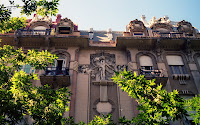
& the disadvantages of Congreso? The endless political demonstrations, noisy with drums and shouting, the streets closed off, and riot police, backed up by water cannon. Not that I ever saw them do anything.The Confitería El Molino is one of the most extravagant – and decayed – buildings in the district. Completed a decade or so after the Congreso, it became a favourite meeting place for local cultural, business and political figures. The café was closed in 1997, and today is only rarely opened to the public except for events advertising the urgent need to restore the building. Derelict and boarded up, it appears to be falling apart. The more strange because it is just across the road from the Congress building itself, a great contrast of styles, the well-maintained austere American/Hellenic Capitol/Congress commanding serious respect, with the almost wilfully bizarre Molino, which almost urges you not to take it seriously, a fun building. I think Tangocherie wrote about it and the well-used dance floor there, but I can't find the reference.


(Just a note here: the UK has an ornate Parliament building as its predecessor burned down during a short period when Gothic was fashionable. A few years earlier or later, and our Parliament would have been a serious block of Portland stone.)
Wandering round the streets reveals other less fantastic but still fabulous buildings, with wonderful details.


But nothing prepared me for turning a corner and coming across this. Those nymphs must be at least three metres tall, and the putti above the size of a grown human. They look like marble, and could well be, but are more likely to be stucco, perhaps mixed with with marble dust. I can't help wondering who chose to sit on that balcony between those nymphs for a morning coffee. & in that quiet, tree-lined side street it would still be exceptional.
Friday, 16 March 2012
Improvised?
Tango is improvised? People say that, but I wonder if it's the right word. You could say disco is improvised: it's not really a partner dance and you can make up your moves as you go along, wave your arms around, jump up and down, throw your head back and forth. In tango you are holding your partner close to you; there are limits.
Ricardo Vidort said you can make up moves in tango, but tango itself is a limited framework, which is part of the beauty of it. I think 'making up moves' is more like finding new connections between things you've done hundreds of times, and practised through dancing. In effect, you've practiced over and over again even the simplest things like taking a step forwards until, as Fred Astaire (who practised obsessively) said, 'your body tells you what to do', you no longer have to think about it or make a conscious effort, your body is free to dance, to be spontaneous. Astaire's dance, of course, at source wasn't in the least spontaneous – it became spontaneous with practise.
Tango might be spontaneous, rather than improvised. There's an element of freedom, but so much of what forms the dance is very far from being improvised. Part-improvised, perhaps, in the way musicians improvise music: their music arises from working on practising their instruments, practising improvisations over and over again, probably studying harmony and counterpoint, and listening closely to improvised music, too.
Ricardo Vidort said you can make up moves in tango, but tango itself is a limited framework, which is part of the beauty of it. I think 'making up moves' is more like finding new connections between things you've done hundreds of times, and practised through dancing. In effect, you've practiced over and over again even the simplest things like taking a step forwards until, as Fred Astaire (who practised obsessively) said, 'your body tells you what to do', you no longer have to think about it or make a conscious effort, your body is free to dance, to be spontaneous. Astaire's dance, of course, at source wasn't in the least spontaneous – it became spontaneous with practise.
Tango might be spontaneous, rather than improvised. There's an element of freedom, but so much of what forms the dance is very far from being improvised. Part-improvised, perhaps, in the way musicians improvise music: their music arises from working on practising their instruments, practising improvisations over and over again, probably studying harmony and counterpoint, and listening closely to improvised music, too.
Wednesday, 7 March 2012
El Nene
I've somehow managed to think online about tango for four years (four years and one week to be exact) with hardly a mention of El Nene, although I've known of him from videos. I don't recall seeing him dance, but there are plenty of videos on YouTube. What's particularly interesting about this one is that it was uploaded just a few days ago: that is, he's around and teaching right now. If you live in Europe or the US this might not be news; you might have enjoyed the good fortune of watching him, of dancing with him, of learning with him. But if you are in the UK, it's quite possible you've never heard of him. I can't help repeating myself: we've been missing out for years, and we still are.
Difficult to find out much about him: the only biographical info seems to be on the milongueando site, which sadly has been infected with something nasty and isn't safe to visit (www.milongueandoenba.com/new/english/p_nene.html - avoid it). This incomplete sentence occurs in my (StartPage) search result: 'Eduardo 'El Nene' Masci has been dancing tango in Buenos Aires for 50 years. The youngest of seven sons brought up in the barrios of...' But do you really need a biography when you can watch dance like this? I can watch the opening 30 seconds, the walk, of this over and over (well, and the rest of it too), right from the first step, so clearly and completely led with the whole body. There's a complete attention to the lead, a complete absorption in the music. There's a gentleness and softness about it, it's so inevitable that you hardly think of it as leading; the music just seems to draw Elisabetta Cavallari and El Nene along the lines of melody and the rhythm. A fabulous Troilo track, a great sensuality of music and movement.
&... well, wouldn't it be great to have someone like this in London, in the UK? To watch this quality of tango, perhaps to dance with someone like this? I wonder what workshops with a tanguero like this would be like. I guess they'd be very much like the dance: perhaps dazzling on the surface only in moments, but something that would continue to inform how you dance, how you felt about the music, for a long while.
& there's a great Troilo tango then vals here, from a week or two ago. Better video quality too.
(Rovigotanto were the hosts for this, run by Elisabetta: they are centred in Boara Pisani, about 60 km south-west of Venice. That area of north Italy, Milan, Venice, Ferrara, is home to several great dancers from Argentina, and regularly invites others. Rovigotango videos are here on YouTube. There's quite a wealth of great tango there, including video of their milongas. It's evident from their website that the milongas are run along quite formal Buenos Aires lines; in fact you can see the separate seating of men and women in the videos.)
PS: I find the red light a bit over the top. The world must look wonderfully green outside.
PPS: The following seems to be the Spanish version of what can't be read in English:
Eduardo Masci baila el tango en Buenos Aires hace 50 años. Es el mas joven de siete hermanos criados en los barrios de Caballito y Boedo, ha sido apodado como “el nene” cuando siendo solamente un chico aprendió el tango de sus ermanos mayores.
A los diez años ya estaba bailando y cuando tenía 14 era un habitué de las milongas mas populares de la época como el Club Huracán y el Club Buenos Aires entre otros. Trabajo para el Estado toda su vida pero su pasatiempo fue siempre bailar y con los años fue desarrollando su particular estilo por el que es muy respetado. A menudo hace exhibiciones en las milongas más importantes de Buenos Aires y hace pocos años comenzó a viajar al exterior a enseñar y exhibir su tango. Maestros de Milongueando organizado por Maria Plazaola y Susana Miller y jurado al Campeonato Mundial de Tango en Buenos Aires.
Difficult to find out much about him: the only biographical info seems to be on the milongueando site, which sadly has been infected with something nasty and isn't safe to visit (www.milongueandoenba.com/new/english/p_nene.html - avoid it). This incomplete sentence occurs in my (StartPage) search result: 'Eduardo 'El Nene' Masci has been dancing tango in Buenos Aires for 50 years. The youngest of seven sons brought up in the barrios of...' But do you really need a biography when you can watch dance like this? I can watch the opening 30 seconds, the walk, of this over and over (well, and the rest of it too), right from the first step, so clearly and completely led with the whole body. There's a complete attention to the lead, a complete absorption in the music. There's a gentleness and softness about it, it's so inevitable that you hardly think of it as leading; the music just seems to draw Elisabetta Cavallari and El Nene along the lines of melody and the rhythm. A fabulous Troilo track, a great sensuality of music and movement.
&... well, wouldn't it be great to have someone like this in London, in the UK? To watch this quality of tango, perhaps to dance with someone like this? I wonder what workshops with a tanguero like this would be like. I guess they'd be very much like the dance: perhaps dazzling on the surface only in moments, but something that would continue to inform how you dance, how you felt about the music, for a long while.
& there's a great Troilo tango then vals here, from a week or two ago. Better video quality too.
(Rovigotanto were the hosts for this, run by Elisabetta: they are centred in Boara Pisani, about 60 km south-west of Venice. That area of north Italy, Milan, Venice, Ferrara, is home to several great dancers from Argentina, and regularly invites others. Rovigotango videos are here on YouTube. There's quite a wealth of great tango there, including video of their milongas. It's evident from their website that the milongas are run along quite formal Buenos Aires lines; in fact you can see the separate seating of men and women in the videos.)
PS: I find the red light a bit over the top. The world must look wonderfully green outside.
PPS: The following seems to be the Spanish version of what can't be read in English:
Eduardo Masci baila el tango en Buenos Aires hace 50 años. Es el mas joven de siete hermanos criados en los barrios de Caballito y Boedo, ha sido apodado como “el nene” cuando siendo solamente un chico aprendió el tango de sus ermanos mayores.
A los diez años ya estaba bailando y cuando tenía 14 era un habitué de las milongas mas populares de la época como el Club Huracán y el Club Buenos Aires entre otros. Trabajo para el Estado toda su vida pero su pasatiempo fue siempre bailar y con los años fue desarrollando su particular estilo por el que es muy respetado. A menudo hace exhibiciones en las milongas más importantes de Buenos Aires y hace pocos años comenzó a viajar al exterior a enseñar y exhibir su tango. Maestros de Milongueando organizado por Maria Plazaola y Susana Miller y jurado al Campeonato Mundial de Tango en Buenos Aires.
Tuesday, 6 March 2012
Joaquín Amenábar
More good news, as Tango en el Cielo says. Bandoneón player and leader of Orquesta Típica de la Guardia Vieja of Buenos Aires, Joaquín Amenábar will be in London Saturday and Sunday 17 - 18 March teaching workshops at Tango en el Cielo on tango music for tango dancers. Joaquín has created a method for teaching dancers with no musical training how tango music works and how to dance to it, how to move with the music. Please see details here.
PS: I wrote about Joaquín's last visit here.
PS: I wrote about Joaquín's last visit here.
Sunday, 4 March 2012
The good news...
For anyone within reach of London, in case you haven't heard, Carablanca is having an extended evening on Friday 16 March. No class, just dancing, 8 to 2am, with DJ Bernhard Gehberger from Vienna. Six hours, a full-length milonga! A mini-festivalito! Great if you can't afford to travel far for a good evening of tango.
Thursday, 1 March 2012
Start Page
To celebrate Google's new 'privacy' policy, I've added a new box on the right of this column, Start Page search, right under the Tango Blog List. Start Page (it used to be Starting Page) is ingenious: it uses Google search, but doesn't pass on the ID of your computer, doesn't, in fact, even note the ID of your computer. So you get to use Google without Google knowing where your search is coming from. This extra stage in a search means a delay which I've found imperceptible, but bearing in mind what a detailed picture of you your search engine is building up, it's probably worth it.
Anyone knows anything wrong with Start Page, do let me know.
PS. The button to click to search is to the right of the box: if you aren't using full page width you may not see it. However, if you click on 'Start Page' it will take you to the main search page.
Anyone knows anything wrong with Start Page, do let me know.
PS. The button to click to search is to the right of the box: if you aren't using full page width you may not see it. However, if you click on 'Start Page' it will take you to the main search page.
Saturday, 25 February 2012
Sergio Larrain
Sometimes I'm not sure how far to take Tangocommuter. After all, a blog with that name ought to be about tango, but on occasions it's been about other things altogether, things that interest me but perhaps no one else. Perhaps the name was shortsighted of me: something a bit more general might have been better. I wonder about publishing notes about films I've seen, exhibitions, places I've visited... I've even thought about a separate blog for the non-tango stuff, but TC might get a bit thin on the ground, especially now that I feel I've got through a time of discovery of tango, and I don't want to start repeating myself. Anyway, this one has a vague tango connection.
Last September I posted about Argentine author Julio Cortazar who was in Buenos Aires during the 1940s into the 1950s, and has left an unromantic but no doubt accurate description of a milonga of the era. He left Buenos Aires for Paris in the 1950s, and while there wrote a story called Las Babas del Diablo, 'devil's drool', which was read by Antonioni who adapted it for screen and called it Blow Up. Cortazar's story has no murder, nothing sensational, just a momentary uneasy encounter between an adolescent and a well-dressed lady, observed by a man in a car.
I've just found out where Cortazar got his story from. He had a friend in Paris, a young Chilean photographer called Sergio Larrain who had an extraordinary eye for street photography. Larrain found that uneasy encounter between two people in one of his enlargements. It wasn't why he took the photo, and he wasn't aware of it as he took the photo; it was just there in the blow-up. The story obviously resonated with Cortazar, and in turn with Antonioni too. But I much prefer Larrain's original story. Cortazar imagined he photographed the scene, thereby disturbing the participants and giving the young man the chance to escape, so the scene ended. Larrain didn't notice the scene until much later, so it was open-ended. He must have sat and looked at his blow-up and wondered what happened next.
You can hunt down his photos on the web. I love this:

It's not a photo of Trafalgar Square: it's an image made in Trafalgar Square that is open-ended, as images are: the difference between a photographer and a person with a camera. It can be seen in different ways by different people, and it's new and marvellous to look at. All his photos are.
He's not so well known because he dropped out in 1972, went and lived in the Andes, meditating and teaching yoga. He gave up photography and painted. He died a few days ago. I found the story here.
Last September I posted about Argentine author Julio Cortazar who was in Buenos Aires during the 1940s into the 1950s, and has left an unromantic but no doubt accurate description of a milonga of the era. He left Buenos Aires for Paris in the 1950s, and while there wrote a story called Las Babas del Diablo, 'devil's drool', which was read by Antonioni who adapted it for screen and called it Blow Up. Cortazar's story has no murder, nothing sensational, just a momentary uneasy encounter between an adolescent and a well-dressed lady, observed by a man in a car.
I've just found out where Cortazar got his story from. He had a friend in Paris, a young Chilean photographer called Sergio Larrain who had an extraordinary eye for street photography. Larrain found that uneasy encounter between two people in one of his enlargements. It wasn't why he took the photo, and he wasn't aware of it as he took the photo; it was just there in the blow-up. The story obviously resonated with Cortazar, and in turn with Antonioni too. But I much prefer Larrain's original story. Cortazar imagined he photographed the scene, thereby disturbing the participants and giving the young man the chance to escape, so the scene ended. Larrain didn't notice the scene until much later, so it was open-ended. He must have sat and looked at his blow-up and wondered what happened next.
You can hunt down his photos on the web. I love this:

It's not a photo of Trafalgar Square: it's an image made in Trafalgar Square that is open-ended, as images are: the difference between a photographer and a person with a camera. It can be seen in different ways by different people, and it's new and marvellous to look at. All his photos are.
He's not so well known because he dropped out in 1972, went and lived in the Andes, meditating and teaching yoga. He gave up photography and painted. He died a few days ago. I found the story here.
Wednesday, 15 February 2012
On being a tango commuter 2
It was mainly because I moved out of London, but it was also an accident of timing. In the early 2000s Ricardo Vidort and possibly Gavito taught regularly in London. I was lucky enough to come across what was probably Ricardo's last class ever in London soon after I started. I say 'come across' because I'd no idea who he was; I turned up that evening quite by chance. Later I realised what a wonderful chance it was, such a relief after miserable classes spent in a futile attempt to master Pablo Veron's choreography, wondering where the music had gone to. & it was Ricardo who said 'Hold your partner close!' That one class gave me a glimpse of the kind of energy and life, the sheer enthusiasm and happiness tango was, or could be. No wonder I was dissatisfied with London tango as I was encountering it.
Six months or so later, when YouTube got going, I found another name, or pair of names, Tete and Silvia. You mean BsAs tango isn't a salida, then an ocho, then a giro, then an ocho cortado, then a cross? It all runs together in one impulse, one energetic movement that relates so closely to the phrases of the music? That's what I want! I watched Ney Melo's videos over and over, open-mouthed. Thank you so much, Ney! No one taught that, let alone danced it, in London! From YouTube I began to realise that Tete and Silvia taught all over Europe, but never in the UK: since I could never find advance dates for their Europe tours I decided I had to go to Buenos Aires and hope they were there. I knew by then that Ricardo Vidort had died, so I went to meet Tete and Silvia. & they were there. More enthusiasm and happiness, and the moving presence of a couple who loved nothing more than dancing together. & of course there were others too who danced the tango of Buenos Aires.
So when I'm asked what I think of the European 'festivalitos' I have to say I really don't know. (Why 'festivalito' by the way? Why the diminutive? They aren't small, are they? & I think 'fiesta' would be the usual Spanish; doesn't 'European Tango Fiestas' sound much better?) On my first trip to BsAs over four years ago, I couldn't understand or communicate a lot, but I could get by. I didn't get many dances at first, but I was usually very satisfied with what I got. So for four years, during which time the 'festivalito' movement has grown so wonderfully in Europe, my tango thoughts have been elsewhere. & I think the teaching of close embrace social tango in the UK has generally got itself together during that time. Not that I've paid much attention to it I'm sorry to say; I've usually got plenty enough memories from a dozen or so classes stacked up in my mind to keep me occupied between yearly visits. (I call them 'classes' but for the most part they are practica sessions with portena dancers with long experience of the milongas, whose feedback and advice is incredibly valuable.)
It's as if there was a gap in London teaching between the early 2000s and 2010, give or take a few years. Dancing close embrace when I started seemed something of an endeavour: perhaps it would have been in 2000 too, but at least at that time there were sometimes teachers who encouraged it. & if you want to dance close now it's not hard to find people who can help and support and encourage you. This blog, and others, partly grew out of trying to make sense of and communicate what we were trying to dance at that time. It seemed all very new, and it took a while to find teachers who could help make sense of it.
I do look forward to taking part in a 'festivalito'... the diminutive is really irritating! Start again: I look forward to taking part in a great tango fiesta! I'm sure there's good dancing, but I know I'll always want to go back to Buenos Aires while it's still possible to sit in wonderful milongas and watch and meet dancers with over 60 years of tango behind them, and I'll probably still want to go there after they've gone, too. I'd urge everyone to think of taking the plunge while those older dancers are still there and on the floor; it's something else altogether. & I have to say, as a city it does start to get under your skin, resist it as you might.
Six months or so later, when YouTube got going, I found another name, or pair of names, Tete and Silvia. You mean BsAs tango isn't a salida, then an ocho, then a giro, then an ocho cortado, then a cross? It all runs together in one impulse, one energetic movement that relates so closely to the phrases of the music? That's what I want! I watched Ney Melo's videos over and over, open-mouthed. Thank you so much, Ney! No one taught that, let alone danced it, in London! From YouTube I began to realise that Tete and Silvia taught all over Europe, but never in the UK: since I could never find advance dates for their Europe tours I decided I had to go to Buenos Aires and hope they were there. I knew by then that Ricardo Vidort had died, so I went to meet Tete and Silvia. & they were there. More enthusiasm and happiness, and the moving presence of a couple who loved nothing more than dancing together. & of course there were others too who danced the tango of Buenos Aires.
So when I'm asked what I think of the European 'festivalitos' I have to say I really don't know. (Why 'festivalito' by the way? Why the diminutive? They aren't small, are they? & I think 'fiesta' would be the usual Spanish; doesn't 'European Tango Fiestas' sound much better?) On my first trip to BsAs over four years ago, I couldn't understand or communicate a lot, but I could get by. I didn't get many dances at first, but I was usually very satisfied with what I got. So for four years, during which time the 'festivalito' movement has grown so wonderfully in Europe, my tango thoughts have been elsewhere. & I think the teaching of close embrace social tango in the UK has generally got itself together during that time. Not that I've paid much attention to it I'm sorry to say; I've usually got plenty enough memories from a dozen or so classes stacked up in my mind to keep me occupied between yearly visits. (I call them 'classes' but for the most part they are practica sessions with portena dancers with long experience of the milongas, whose feedback and advice is incredibly valuable.)
It's as if there was a gap in London teaching between the early 2000s and 2010, give or take a few years. Dancing close embrace when I started seemed something of an endeavour: perhaps it would have been in 2000 too, but at least at that time there were sometimes teachers who encouraged it. & if you want to dance close now it's not hard to find people who can help and support and encourage you. This blog, and others, partly grew out of trying to make sense of and communicate what we were trying to dance at that time. It seemed all very new, and it took a while to find teachers who could help make sense of it.
I do look forward to taking part in a 'festivalito'... the diminutive is really irritating! Start again: I look forward to taking part in a great tango fiesta! I'm sure there's good dancing, but I know I'll always want to go back to Buenos Aires while it's still possible to sit in wonderful milongas and watch and meet dancers with over 60 years of tango behind them, and I'll probably still want to go there after they've gone, too. I'd urge everyone to think of taking the plunge while those older dancers are still there and on the floor; it's something else altogether. & I have to say, as a city it does start to get under your skin, resist it as you might.
Subscribe to:
Posts (Atom)