Wednesday, 30 May 2012

Muma with Osvaldo Natucci


Well worth keeping an eye on Bendtango's channel: there's another video of Muma dancing with Ricardo Vidort that appeared there about a week ago. But there's also a condensed version of a vals tanda of Muma dancing with Osvaldo Natucci (in light shirt and hair) at El Beso in 2000, which I keep watching over and over. It brings it all back! & it's as well filmed as could be, given how close everything is, and the rather low lighting levels. Really a sense of sitting right there, watching the surging movements of the torsos, and looking down at the tiny neat steps, absolutely in time with the music, that keep couples gliding around, seeing just how close people are dancing. It could be more crowded, but I'd say this is about optimal: you wouldn't want more people, or it gets difficult, but there are enough to create a real buzz. Osvaldo holding Muma with real care and affection, and Muma looking totally radiant. Guys, do your partners look anything like this relaxed and happy when you lead them? Something to work for, isn't it?
 
Wonderful. Thanks Bendtango.

Saturday, 26 May 2012

Grounded


It was great to meet up recently with a friend I'd met in BsAs. Of course we went out dancing, and had time to chat about tango and old friends.

Something that interested me: I said I thought nuevo, and Gustavo's dance (which I believe he calls salon), isn't particularly new, it's a kind of tango that goes way back. & she disagreed. 'No, when you dance with leaders who've learned that way, they don't stay grounded. The experience, the feel of it, is tango becoming balletic, tango trying to fly. The beauty of tango, the real pleasure of it, is how grounded it is. Nuevo is 'nuevo' because it's taken the old dance and given it a different dimension, a whole different feel, and that new dimension has taken away the pleasure of it. The real pleasure of tango is how grounded it is.'

I've had plenty of objections to 'nuevo', being kicked for one, of course, as well as the confusion created by the erratic movements of nuevo dancers, but I have to admit I've never actually been led by a nuevo leader, so this was a whole new idea to me. I remembered the late Tete's statement: tango is danced in many ways, but always on the floor, and that is where it gets its energy. The whole idea of being grounded in tango has always fascinated me: a lot of European dance seeks to fly, at least to jump up and down. 
 
We talked about learning Canyengue before tango, but she wasn't sure it would help: the change in direction used in the basic step isn't so easy to lead and follow, '...but people would learn to be grounded if they learned canyengue first.' The 'leaning together' of canyengue dancers is much more pronounced than in tango, your feet are further away from your partner's feet, which gives a much stronger feeling of weight and connectedness, both to each other and to the floor. Immigrants, exiles, devising a dance like no other, that forces them physically together and holds them down in place.

Tuesday, 22 May 2012

Ricardo again!

...and tango181 (Bendtango) has just uploaded another short extract of Ricardo Vidort at the milonga Bien Jaileife in July 2001.


Fascinating to watch not only Ricardo but the other dancers too.

I found a long and interesting quote from Ricardo on Jenney Surelia's blog, but I couldn't get the link to work, (it's http://tangothoughts.typepad.co.uk/tango_thoughts/quotes/ but it lead me to a blank page.) It obviously worked in the past since I copied the quote. Since I can't link it, I hope Jenney won't mind if I put it here in full. Ricardo said:

To explain what is a milonguero, is really very difficult, because the feeling of this beautiful emotion is something new to each person. It is almost impossible to put it in words. But I shall try to do it, and I hope without offending or hurting anybody's feelings.

To be a milonguero, first of all you have your own style of dancing. It means that you have a unique feeling for the music, rhythm, cadence and embrace. When you have all this, the music invades your body and mind and then, only then, the chemistry begins that really makes you transmit to your partner as if both were talking, whispering, sliding on the floor with sacadas, corridas, turns, dancing only one for the other, not for the people. In that moment, when both are listening to the magic of the music, the skin of one in the skin of the other, the smell, the touch produces the miracle of something like a mantra, and the ying and the yang is there!!! We are dancing tango!!!

The priorities of a milonguero are the feeling and the woman. The codes are like the commandments which were born with the tango, and the music is defined in three parts. The first is a question, the second is a pause or prologue, the third part holds an answer. All this is in our feeling and this is why we always improvise, having the pleasure of being ourselves, in our own style with the rhythm and the cadence. Today people teach in methodic ways, but the tango, the real Tango Salon, does not have method, because it is a feeling. Technique and choreography are only for performance, this is tango which has been learned for hours for show business; there are hundreds of couples doing the same thing, and only a few of them, let us say ten or fifteen are really very good because they are different and that is another thing. Every tango dancer of the streets, those who practised in the squares or parks, with other men, developed technique naturally, without knowing it. His steps and feeling were a technique. My advice is - walk, walk with your toe first and always in the music, walk and practise to be yourself and not a copy of anybody else.

Jenney Surelia's blog

Friday, 18 May 2012

Ricardo and Muma

Janis has very kindly drawn my attention to a new video of Ricardo Vidort, always a cause for celebration! & what a video! Ricardo and Muma dancing, no less, and in a milonga too. Sadly it's brief, but that makes it easier to watch over and over. It's wonderful stuff: the beginning is especially magical, the way they glide into view with a musical phrase – but then it's magical throughout.


The music is wonderful, too: Cuatro Palabras by Adolfo Carabelli.

This and other videos, particularly of Muma, are on Bendtango's YouTube channel. Bendtango has also uploaded a cleaned-up version of the video of Muma's Milonga Criolla with El Flaco Dani. One can only be grateful to people like Bendtango who filmed these dances years back, and hope there's more to come! It's through old videos like these that we really get a glimpse of tango at its best.


Wednesday, 9 May 2012


Since we're on the topic, here's Tuesday night Cachirulo at its new home, Boedo Tango, San Juan 3330. Looks good, reminds me of Maipu 444 in layout, although there's obviously more space around. This seems to be the first video they've uploaded from the new venue.


The query is: Thursday night Lujos. Depending on where you look, it's at Lo de Celia or La Nacional. Lo de Celia would preserve the intimate, friendly atmosphere of Lujos at El Beso. La Nacional is an entirely different venue, but very beautiful.

Monday, 7 May 2012

El Beso

So the rumours that have been swirling around the last few weeks are true: El Beso has been closed down. Jantango has confirmed it. I shouldn't be surprised, having been there when it felt crowded to the point of being unsafe. It also means that if it can be made safe it could reopen; depends on whether the owners think it's worth it, I guess. It has plenty of history, but it was small and crowded, and dingy, too, and the lighting wasn't great. There's a demand for milongas, so all the activities will move elsewhere. There are alternatives, some of them a lot more spacious.

Wednesday, 2 May 2012


I hear that both Alberto Dassieu and Ricardo Viquiera are in Switzerland this month.
Here are Alberto and Paulina in a great video from Irene and Man Yung. I especially like this one because they are dancing in a milonga, but it's not crowded. I've often watched Alberto and Paulina in crowded milongas: he leads with all the feeling for the music that's evident in this dance, but slowly, with a lot of pauses, quite cautiously, moving decisively only when he has room; it's a good lesson, a kind of minimal tango. Here he has plenty of space to enjoy the dance no need to be minimal. Still, every Thursday night they turn up at El Beso and sit and eat at a tiny table, crowded in with people coming and going and greeting them, they dance on the crowded floor, and Alberto beams with happiness: such a great milonga tonight! Alberto grew up with Villa Urquiza tango, but not the Villa Urquiza of many contemporary teachers, who use the name for a dance of big gestures. There's something very 'trained', very precise, about Alberto's walk, the way he steps and moves, effortlessly smooth and musical but very passionately with the music. That quite disciplined walk isn't really like the walk of many other local dancers.
'Que vals!' as he would say.

 And Ricardo Viquiera: a neat demonstration of floorcraft this, worth watching again. Ricardo is also clear about the right way to walk and move, not for aesthetic reasons, not because something looks good, but quite simply because it works better that way. As his video demonstrates! He has an excellent reputation for spotting areas where dancers need help, where things aren't quite right.
I guess Ricardo will be around for a few months in Europe...


PS: Sorry to hear that my information is out of date: Alberto had to cancel his visit to Switzerland. But the video still looks great!

Friday, 27 April 2012

Carablanca again...

Don't believe everything you read in the papers... or on the internet, and especially in blogs! I must correct what I said about the music at the milonga that became Carablanca many years later. As Tango en el Cielo kindly pointed out, there was a variety of music. & I was even wrong to say that there was just one CD. Totally wrong, because (I now hear, on the very best authority) there wasn't even one CD: all the music was on cassettes brought over from Buenos Aires, and of varying quality. & when one side of the cassette had played, someone would turn it over, and the dancing would go on. Since the cassettes were of single orquestas, an evening's dance might be two or three orquestas, an hour or ninety minutes each. Tango CDs, tandas and DJing all came years later.

Curiously, this must have echoed the music of the golden age milongas, since in that era you were likely to get only one orquesta in the evening. If Pedro Laurenz was playing for you, you wouldn't get neat tandas of Di Sarli, Canaro, D'Agostino and others. (& with live music like that you probably wouldn't miss them either!)

 & many thanks to the tango pioneers of London who started milongas like Carablanca many years ago and have kept them running for us to enjoy!

Sunday, 22 April 2012

Carablanca's big night out

Recently, for one evening, as a trial, Carablanca milonga in London decided to dispense with a pre-milonga class and use the time instead for dancing. In a bold move the organisers also decided to get an extension, so the milonga started at 8 and finished at 2am. Moreover, they brought in a really good DJ, Bernhard Gehberger. It seems to have been a big success. Plenty of people were on the floor from start to finish, and it was remarkable that almost all the dancing was close or close-ish embrace. It wasn't as disciplined and restrained as a BsAs milonga, but then Londoners haven't had years of practice at dancing on crowded floors. (All it takes is practice! It's not something you can learn in classes!) Although it's a fair-sized hall, the organisers have limited the amount of space available for dance, so everyone is developing the skills needed for tango at a traditional milonga.

I gather that when the Welsh Centre milonga, Carablanca's previous incarnation, started out they had just one CD, a Troilo CD that those who remember those days know by heart, and that it was known as a place for kicking and being kicked. (I hope I'm not maligning it: this was years ago, anyway.) From that to six hours of excellent music, and reasonably good dance too: times have changed for the better I think! It parallels some comments made recently by Irene and Man Yung about Toronto tango: perhaps Toronto has gone through the same transformation as London within a similar timescale. (It's a hilarious post if you haven't already seen it.)

& the good news is that there's more of this coming up. I hear that there are several evenings without a pre-milonga class arranged for the next few months, a full four hours of dance each night, and that an extension until 2am for a further evening has been applied for. Combined with bookings of first-rate DJs, there are some really good evenings to look forward to. Keep an eye on the website.

Tuesday, 17 April 2012

Pedro Sanchez again

I keep watch for friends on YouTube but hadn't checked out Pedro Sanchez for a while. There's one new video, posted last October. On the beautiful inlaid floor of the practice room of Alejandro Gée's guest house, Casa Tango Angelitos, and the track is Pedro's kind of tango, the wonderfully passionate D'Arienzo song, Amarras. (Tango and Chaos has the story, the words and a translation here.) It's very clearly filmed too. & at 2:59 something that looks almost like a nod to the late Tete: I can't recall seeing anyone else do that. Many thanks to Hsueh-tze Lee.


I can't help feeling that you can learn everything you need to know about leading from a video like this – by which I mean that I recognise everything I need to be able to do... and I'm not really thinking about feet. 'Con el cuerpo!' as he says, 'With the body!' & watching his partner makes me think of something I've noticed in porteño ladies, something very few non-locals seem to have picked up; they seem to show a slight hesitation before stepping. I don't know if anyone else sees that too, but it seems to bring a slight, sensuous indolence into their dance. You wanted to dance with me? So make me dance! Not a few Europeans I've danced with are more likely to anticipate the beat.

Here's one of Jantango's two marvellous videos of Ismael Heljalil. I'm not sure that his partner is local, but she never seems to rush into a step. It's as if she steps at the last possible moment. Or am I imagining things?

But this post is about Pedro so he should have the last word. Here's Tina's five-second video of Pedro.

Saturday, 7 April 2012

Shooting the feet, slow motion

Many thanks for the comments on Meeting Myriam. As often happens, there's a lot there that's interesting.

As to the embrace, I was very struck by Myriam's point that the main contact is between the lower side of the woman's left arm and her left side, and the upper side of the man's right arm, and rarely ever with his right hand. If his right hand becomes the dominant contact then the embrace is likely to be tight. But I can't help thinking that women generally need to be aware of this too, they need to seek out that side of the contact. Man's right to woman's left arm and side, and the contact of hands on the other side, form the classic 'frame', with the contact of torsos directly in between. (I wonder: if the woman's arm is over the man's right shoulder, isn't half of the frame missing, or at least less effective?) She also spoke about varying the hold: when the man dances to the woman's left he needs to be firmer, and when he leads turns he needs to give more space. This seemed to me a difficult thing to control, but it might be essential.

(Incidentally, she was speaking in English. Her English isn't exactly fluent but it is clear, and she has the instinctive teacher's perception of any stress, which can hinder learning and understanding, and she immediately relaxes your attention with some good-humoured comment, often about her English. Too many teachers in general imagine that if they just hammer on they will get their point across.)

Thanks for the comments on 'shooting the feet', especially Tango en el Cielo's remark that Ricardo regarded 'shooting the feet' as '… a very masculine characteristic, one of the qualities of dancing that distinguished a woman's way of dancing from a man's'. I love the description of Ricardo going '...pad, pad, pad, as if he was in slippers', and RealityPivot's description of 'foot punctuation' too. But verbal description is limited and I wanted to look at some slow-motion video of Ricardo 'shooting the feet'. I think it's common to that generation of dancers, although perhaps it's most noticeable and distinct in Ricardo's dance.


Ricardo and Myriam. The full video is on TangoNad's channel.


& here's Ricardo dancing with Jill Barrett in 2004, upright posture, chest well out and leading with the weight well forwards. Perhaps because the weight is well forwards the forward step shoots forwards with added urgency. & it meets the ground exactly on time! The music sounds terrible slowed down, but I included it because it makes sense of the movement. The full video, correct speed, is on TangoCelebration's channel.

I was also fascinated to hear from Tango en el Cielo that '...Ricardo eschewed technique. He believed that technique analysis was only for stage dancers; social dancers didn't need it as "the body finds its own technique naturally"'. I guess the 'own technique' you find that way, naturally, is your own individual tango. Technical analysis seems like a short cut for people in a hurry, a verbal, cerebral practice that will never build up the muscle memory or get the results developed from hours and hours of dancing and watching dance.

We are never passive when we watch. Our muscles follow instinctively, which is how we can imitate: we've been through it before. Watching, too, builds muscle memory. But a YouTube screen is a bit small: it would be great if we had an hour or so of high quality film of Ricardo and others, to watch full-size on a big screen, our bodies relaxed in a cinema seat, before we go dancing. Well, maybe one day there will be algorithms that can take old video and make a beautiful clear HD image from it...

Friday, 30 March 2012

'Cacho' Dante


It made me so happy to see this. Cacho is a great teacher, and he teaches group classes several times a week. Or he used to teach. Last year I found he was no longer teaching as he wasn't well. It looks as if he's back, lively as before. I think he's great because he takes the trouble to watch very intently, and can then make a comment that changes everything about your tango. I think of him as a very generous teacher, and modest. His group classes weren't that expensive, and were serious and intense, and the general standard of dance was good. But they were entirely in Spanish, and most of his students are local.

& I'm also happy to see the dance at the end of the interview because, unbelievably, there's only one video of him on the whole of YouTube. Or at least there used to be; I just checked and noticed that armanyengue1 has recently uploaded two more, dating back to Seattle in 2004. It used to be a great pleasure to watch him in the milongas a few years ago, and I look forward to seeing him again.

Incidentally, talking of 'shooting the feet' I notice how, like Ricardo Vidort, he often lifts his knee a little high so the foot comes down more emphatically, with the leg quite straight. I think this is very characteristic of his generation, although it might not always be so pronounced. Stepping like this emphasises the beat, and pushes the body up straight too. I wrote about his classes here.

Saturday, 24 March 2012

Meeting Myriam

Meticulous and precise, as a teacher and in approach to dance. Ricardo Vidort was neat and precise in his movements. I'm not sure if she taught with him, but she danced with him a lot.

After a single tango she reminds me the details are important: the upright posture, getting the embrace right, the right arm in full contact with the woman's left side but not tight, the left arm and hand firm, so the energy for a turn comes from the full extent of torso and arm. '& STRETCH that leg straight!'

I ask about Ricard Vidort's way of emphatic stepping, almost stamping, and her face becomes radiant; for a moment she becomes Ricardo walking. 'The energy!' she says, walking and turning her torso, eyes shining. Meticulous, precise, funny, friendly and utterly charming.

You don't need to do a lot of complicated things: it's good just to walk well.

The energy down into the ground, yes, the body upright. With the foot, like a cat, soft but strong, not pointed like a classical dancer, on the ball of the foot not the heel, the upper side of the foot leading, the weight forwards. The feet always collecting, stepping into the space left by the partner's foot. The legs straight. Breathe in and then keep the chest raised. The main connection is right upper arm under the woman's left armpit, rarely ever with the right hand. It's a flexible connection, the upper arm and shoulder opening a little in turns to give the woman more space. In turns make sure the upper torso, left hand to right shoulder, stays in line, firmly guiding the giro. Once the leader starts the giro, leave it to the woman to continue the energy. The head angled slightly down to the woman's right shoulder.

Head up and chest out when you go to dance with a lady. I am a winner!

Monday, 19 March 2012

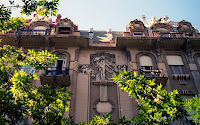
Some buildings

One of the pleasures of living in the Congreso district is the discovery of extraordinary Belle Époque buildings. Most of the city is recent concrete residential blocks, mostly as dull as can be, but in Congreso older buildings have survived. As the name suggests, this area is where the Congress building is, so maybe there were more great mansions there, dating from the days when, as I discover from reading Irene Nemirovsky's short stories of 1930s Paris, a wealthy, generous and good-natured playboy in Paris would be Argentine.

& the disadvantages of Congreso? The endless political demonstrations, noisy with drums and shouting, the streets closed off, and riot police, backed up by water cannon. Not that I ever saw them do anything.


The Confitería El Molino is one of the most extravagant – and decayed – buildings in the district. Completed a decade or so after the Congreso, it became a favourite meeting place for local cultural, business and political figures. The café was closed in 1997, and today is only rarely opened to the public except for events advertising the urgent need to restore the building. Derelict and boarded up, it appears to be falling apart. The more strange because it is just across the road from the Congress building itself, a great contrast of styles, the well-maintained austere American/Hellenic Capitol/Congress commanding serious respect, with the almost wilfully bizarre Molino, which almost urges you not to take it seriously, a fun building. I think Tangocherie wrote about it and the well-used dance floor there, but I can't find the reference.


(Just a note here: the UK has an ornate Parliament building as its predecessor burned down during a short period when Gothic was fashionable. A few years earlier or later, and our Parliament would have been a serious block of Portland stone.)

Wandering round the streets reveals other less fantastic but still fabulous buildings, with wonderful details.


 But nothing prepared me for turning a corner and coming across this. Those nymphs must be at least three metres tall, and the putti above the size of a grown human. They look like marble, and could well be, but are more likely to be stucco, perhaps mixed with with marble dust. I can't help wondering who chose to sit on that balcony between those nymphs for a morning coffee. & in that quiet, tree-lined side street it would still be exceptional.


Friday, 16 March 2012

Improvised?

Tango is improvised? People say that, but I wonder if it's the right word. You could say disco is improvised: it's not really a partner dance and you can make up your moves as you go along, wave your arms around, jump up and down, throw your head back and forth. In tango you are holding your partner close to you; there are limits.

Ricardo Vidort said you can make up moves in tango, but tango itself is a limited framework, which is part of the beauty of it. I think 'making up moves' is more like finding new connections between things you've done hundreds of times, and practised through dancing. In effect, you've practiced over and over again even the simplest things like taking a step forwards until, as Fred Astaire (who practised obsessively) said, 'your body tells you what to do', you no longer have to think about it or make a conscious effort, your body is free to dance, to be spontaneous. Astaire's dance, of course, at source wasn't in the least spontaneous – it became spontaneous with practise.

Tango might be spontaneous, rather than improvised. There's an element of freedom, but so much of what forms the dance is very far from being improvised. Part-improvised, perhaps, in the way musicians improvise music: their music arises from working on practising their instruments, practising improvisations over and over again, probably studying harmony and counterpoint, and listening closely to improvised music, too.

Wednesday, 7 March 2012

El Nene

I've somehow managed to think online about tango for four years (four years and one week to be exact) with hardly a mention of El Nene, although I've known of him from videos. I don't recall seeing him dance, but there are plenty of videos on YouTube. What's particularly interesting about this one is that it was uploaded just a few days ago: that is, he's around and teaching right now. If you live in Europe or the US this might not be news; you might have enjoyed the good fortune of watching him, of dancing with him, of learning with him. But if you are in the UK, it's quite possible you've never heard of him. I can't help repeating myself: we've been missing out for years, and we still are.

Difficult to find out much about him: the only biographical info seems to be on the milongueando site, which sadly has been infected with something nasty and isn't safe to visit (www.milongueandoenba.com/new/english/p_nene.html - avoid it). This incomplete sentence occurs in my (StartPage) search result: 'Eduardo 'El Nene' Masci has been dancing tango in Buenos Aires for 50 years. The youngest of seven sons brought up in the barrios of...' But do you really need a biography when you can watch dance like this? I can watch the opening 30 seconds, the walk, of this over and over (well, and the rest of it too), right from the first step, so clearly and completely led with the whole body. There's a complete attention to the lead, a complete absorption in the music. There's a gentleness and softness about it, it's so inevitable that you hardly think of it as leading; the music just seems to draw Elisabetta Cavallari and El Nene along the lines of melody and the rhythm. A fabulous Troilo track, a great sensuality of music and movement.

&... well, wouldn't it be great to have someone like this in London, in the UK? To watch this quality of tango, perhaps to dance with someone like this? I wonder what workshops with a tanguero like this would be like. I guess they'd be very much like the dance: perhaps dazzling on the surface only in moments, but something that would continue to inform how you dance, how you felt about the music, for a long while.


& there's a great Troilo tango then vals here, from a week or two ago. Better video quality too.

(Rovigotanto were the hosts for this, run by Elisabetta: they are centred in Boara Pisani, about 60 km south-west of Venice. That area of north Italy, Milan, Venice, Ferrara, is home to several great dancers from Argentina, and regularly invites others. Rovigotango videos are here on YouTube. There's quite a wealth of great tango there, including video of their milongas. It's evident from their website that the milongas are run along quite formal Buenos Aires lines; in fact you can see the separate seating of men and women in the videos.)

PS: I find the red light a bit over the top. The world must look wonderfully green outside.


PPS: The following seems to be the Spanish version of what can't be read in English:

Eduardo Masci baila el tango en Buenos Aires hace 50 años. Es el mas joven de siete hermanos criados en los barrios de Caballito y Boedo, ha sido apodado como “el nene” cuando siendo solamente un chico aprendió el tango de sus ermanos mayores.
A los diez años ya estaba bailando y cuando tenía 14 era un habitué de las milongas mas populares de la época como el Club Huracán y el Club Buenos Aires entre otros. Trabajo para el Estado toda su vida pero su pasatiempo fue siempre bailar y con los años fue desarrollando su particular estilo por el que es muy respetado. A menudo hace exhibiciones en las milongas más importantes de Buenos Aires y hace pocos años comenzó a viajar al exterior a enseñar y exhibir su tango. Maestros de Milongueando organizado por Maria Plazaola y Susana Miller y jurado al Campeonato Mundial de Tango en Buenos Aires.

Tuesday, 6 March 2012

Joaquín Amenábar

More good news, as Tango en el Cielo says. Bandoneón player and leader of Orquesta Típica de la Guardia Vieja of Buenos Aires, Joaquín Amenábar will be in London Saturday and Sunday 17 - 18 March teaching workshops at Tango en el Cielo on tango music for tango dancers. Joaquín has created a method for teaching dancers with no musical training how tango music works and how to dance to it, how to move with the music. Please see details here.

PS: I wrote about Joaquín's last visit here.

Sunday, 4 March 2012

The good news...

For anyone within reach of London, in case you haven't heard, Carablanca is having an extended evening on Friday 16 March. No class, just dancing, 8 to 2am, with DJ Bernhard Gehberger from Vienna. Six hours, a full-length milonga! A mini-festivalito! Great if you can't afford to travel far for a good evening of tango.

Thursday, 1 March 2012

Start Page

To celebrate Google's new 'privacy' policy, I've added a new box on the right of this column, Start Page search, right under the Tango Blog List. Start Page (it used to be Starting Page) is ingenious: it uses Google search, but doesn't pass on the ID of your computer, doesn't, in fact, even note the ID of your computer. So you get to use Google without Google knowing where your search is coming from. This extra stage in a search means a delay which I've found imperceptible, but bearing in mind what a detailed picture of you your search engine is building up, it's probably worth it.

Anyone knows anything wrong with Start Page, do let me know.

PS. The button to click to search is to the right of the box: if you aren't using full page width you may not see it. However, if you click on 'Start Page' it will take you to the main search page.

Saturday, 25 February 2012

Sergio Larrain

Sometimes I'm not sure how far to take Tangocommuter. After all, a blog with that name ought to be about tango, but on occasions it's been about other things altogether, things that interest me but perhaps no one else. Perhaps the name was shortsighted of me: something a bit more general might have been better. I wonder about publishing notes about films I've seen, exhibitions, places I've visited... I've even thought about a separate blog for the non-tango stuff, but TC might get a bit thin on the ground, especially now that I feel I've got through a time of discovery of tango, and I don't want to start repeating myself. Anyway, this one has a vague tango connection.

Last September I posted about Argentine author Julio Cortazar who was in Buenos Aires during the 1940s into the 1950s, and has left an unromantic but no doubt accurate description of a milonga of the era. He left Buenos Aires for Paris in the 1950s, and while there wrote a story called Las Babas del Diablo, 'devil's drool', which was read by Antonioni who adapted it for screen and called it Blow Up. Cortazar's story has no murder, nothing sensational, just a momentary uneasy encounter between an adolescent and a well-dressed lady, observed by a man in a car.

I've just found out where Cortazar got his story from. He had a friend in Paris, a young Chilean photographer called Sergio Larrain who had an extraordinary eye for street photography. Larrain found that uneasy encounter between two people in one of his enlargements. It wasn't why he took the photo, and he wasn't aware of it as he took the photo; it was just there in the blow-up. The story obviously resonated with Cortazar, and in turn with Antonioni too. But I much prefer Larrain's original story. Cortazar imagined he photographed the scene, thereby disturbing the participants and giving the young man the chance to escape, so the scene ended. Larrain didn't notice the scene until much later, so it was open-ended. He must have sat and looked at his blow-up and wondered what happened next.

You can hunt down his photos on the web. I love this:

It's not a photo of Trafalgar Square: it's an image made in Trafalgar Square that is open-ended, as images are: the difference between a photographer and a person with a camera. It can be seen in different ways by different people, and it's new and marvellous to look at. All his photos are.

He's not so well known because he dropped out in 1972, went and lived in the Andes, meditating and teaching yoga. He gave up photography and painted. He died a few days ago. I found the story here.

Wednesday, 15 February 2012

On being a tango commuter 2

It was mainly because I moved out of London, but it was also an accident of timing. In the early 2000s Ricardo Vidort and possibly Gavito taught regularly in London. I was lucky enough to come across what was probably Ricardo's last class ever in London soon after I started. I say 'come across' because I'd no idea who he was; I turned up that evening quite by chance. Later I realised what a wonderful chance it was, such a relief after miserable classes spent in a futile attempt to master Pablo Veron's choreography, wondering where the music had gone to. & it was Ricardo who said 'Hold your partner close!' That one class gave me a glimpse of the kind of energy and life, the sheer enthusiasm and happiness tango was, or could be. No wonder I was dissatisfied with London tango as I was encountering it.

Six months or so later, when YouTube got going, I found another name, or pair of names, Tete and Silvia. You mean BsAs tango isn't a salida, then an ocho, then a giro, then an ocho cortado, then a cross? It all runs together in one impulse, one energetic movement that relates so closely to the phrases of the music? That's what I want! I watched Ney Melo's videos over and over, open-mouthed. Thank you so much, Ney! No one taught that, let alone danced it, in London! From YouTube I began to realise that Tete and Silvia taught all over Europe, but never in the UK: since I could never find advance dates for their Europe tours I decided I had to go to Buenos Aires and hope they were there. I knew by then that Ricardo Vidort had died, so I went to meet Tete and Silvia. & they were there. More enthusiasm and happiness, and the moving presence of a couple who loved nothing more than dancing together. & of course there were others too who danced the tango of Buenos Aires.

So when I'm asked what I think of the European 'festivalitos' I have to say I really don't know. (Why 'festivalito' by the way? Why the diminutive? They aren't small, are they? & I think 'fiesta' would be the usual Spanish; doesn't 'European Tango Fiestas' sound much better?) On my first trip to BsAs over four years ago, I couldn't understand or communicate a lot, but I could get by. I didn't get many dances at first, but I was usually very satisfied with what I got. So for four years, during which time the 'festivalito' movement has grown so wonderfully in Europe, my tango thoughts have been elsewhere. & I think the teaching of close embrace social tango in the UK has generally got itself together during that time. Not that I've paid much attention to it I'm sorry to say; I've usually got plenty enough memories from a dozen or so classes stacked up in my mind to keep me occupied between yearly visits. (I call them 'classes' but for the most part they are practica sessions with portena dancers with long experience of the milongas, whose feedback and advice is incredibly valuable.)

It's as if there was a gap in London teaching between the early 2000s and 2010, give or take a few years. Dancing close embrace when I started seemed something of an endeavour: perhaps it would have been in 2000 too, but at least at that time there were sometimes teachers who encouraged it. & if you want to dance close now it's not hard to find people who can help and support and encourage you. This blog, and others, partly grew out of trying to make sense of and communicate what we were trying to dance at that time. It seemed all very new, and it took a while to find teachers who could help make sense of it.

I do look forward to taking part in a 'festivalito'... the diminutive is really irritating! Start again: I look forward to taking part in a great tango fiesta! I'm sure there's good dancing, but I know I'll always want to go back to Buenos Aires while it's still possible to sit in wonderful milongas and watch and meet dancers with over 60 years of tango behind them, and I'll probably still want to go there after they've gone, too. I'd urge everyone to think of taking the plunge while those older dancers are still there and on the floor; it's something else altogether. & I have to say, as a city it does start to get under your skin, resist it as you might.

Wednesday, 8 February 2012

Basics


February again, and as ever I think back to a small basement below the Welsh Centre near Kings Cross, London, some years back, where someone later to be known as Tangocommuter took a few first tango steps, which have led to some wonderful evenings, some great friendships and much more besides. The music was almost certainly D'Arienzo, although it would be year or so before I'd recognise the name or the music. & of course the lesson was walking, and the '8-step basic'. The same way most of us have started out, I expect.

There's a tendency these days to knock this 'basic', but I don't think it's that bad, particularly if it's in six steps. (Eight steps starts with a backstep: not a sensible thing to teach beginners!) After all, after that class I was on the floor in the milonga upstairs, trying to dance that 'basic' with a partner I'd met in the class – and she's a good friend to this day, and we enjoy a dance or two whenever we meet. It didn't turn out badly! No one will ever get to dance tango without actually being on the floor with a partner, and this 'basic' starts people off pretty effectively.

Of course, it's not what you do it's the way that you do it. Lazy teachers suggest that this 'basic' is a pattern of steps that you follow, a choreography, instead of one possible collection of individual steps that can be varied. Maybe teachers who use it should make it clear that, just as the leader takes one step to the left, he/she could then take another step to the left. Or a step back to the right again. So how does the leader communicate the intention to do this? & that, I think, is where tango starts, the leader composing and communicating with the follower. & it's where lazy teachers screw up their students, and screw them, too, by suggesting they need ever more classes where they pay to learn more and more choreographies, when what they really need is an explanation and demonstration of how individual steps can be linked, and how the intention to move can be communicated through the embrace. There's never going to be tango until leaders learn to communicate their intention. When you follow a choreography you don't need to communicate anything at all because your partner knows what's going to happen – which is boring.

It was a year or two before I started to figure out that the choreographies taught in classes weren't discrete entities, they were just more or less ingenious ways of connecting together units/steps that were already familiar. Suddenly I had the feeling that this endless material I was struggling to master belonged to me already. It was mine! That was at least a beginning...

Last summer the BBC gave a rare (these days) treat of a series of dance programmes, which included a programme featuring the conductor Charles Hazlewood bravely exploring the world of dance. (It takes courage to explore the world of physical movement on TV!) One of his visits was to Trinity Laban in Deptford, where he took part in a class. His teacher explained the teaching of Rudolph Laban: 'Dance is made from movement. Movement is, if you like, the raw material of the art form. But quite often, in practice, people come to dance through learning steps, or learning styles or learning techniques, and not necessarily understanding the structure of movement itself.' Thinking back to grim afternoons and evenings spent in futile attempts to perfect back saccadas in intermediate classes, 'understanding the structure of movement' seems a refreshing approach, perhaps not for complete beginners, who need structures like the 'basic', but at least for those who are becoming a bit more confident.

Sunday, 22 January 2012

Roberto Firpo


I posted here about the photo of Roberto Firpo's quintet (or sextet, since it's not really possible to work out the role of the sixth person, singer or musician) in a recording studio. He's not played much in milongas these days: Pedro gave me a compilation CD a few years ago, and that's when I first listened to his music. He lived 1884 – 1969, a close contemporary of Canaro, and made a huge number of recordings with his orquestas, so he must have sold well, but not a lot has been re-released. According to Todotango, from childhood he worked at anything he could to save 200 pesos to buy himself a piano, and said the day he bought it was the happiest day of his life.

This track at the end of CD 1 of the Grandes del Tango Roberto Firpo double CD really caught my ear! (The link opens a player in another website.) Solo piano, and more wistful, measured and melancholic than recordings I've listened to with his orquesta, perhaps more personal. The music somehow reminds me of a Haydn sonata, even simple Chopin, and the playing makes the structure of the music very clear. But somehow it also has an overtone of early jazz, Scott Joplin perhaps, who died in 1917. The rhythm is habanera, the milonga-like beat of early tango, but the playing is more romantic in style than early tango. A fascinating, elegant piece of music.

A while back I talked with a young BsAs musician and told her that my love of tango music seemed strange to me, given that I used to listen only to jazz and baroque. 'But there's a lot of connection between tango and baroque!' she replied immediately. 'Think about it!' Well, I've thought about it ever since without being quite sure what she was talking about until I heard this track. Tango orchestration might have the energy and sound and emotional charge of late 19th century opera, but perhaps she meant that the structure of the music is simpler and older, like an old house with a grand late-19th century facade.

Saturday, 14 January 2012

Milonga watching 2

A quick note: I'm simply trying to describe as accurately as I can my impressions of BsAs milongas. I don't intend any of this as a criticism of London or any other milongas. & perhaps the best way to describe the (few) Buenos Aires milongas I've enjoyed is to say that they are socially laid-back and slightly formal. The dancing, and the brief conversations between tangos, are the focus. I guess that public dances always used to be a bit formal, and something of that spirit persists.

When you first arrive at (say) El Beso and start watching the dance, the quality of it seems overwhelming. It's excellent; these are all people who've danced a lot. But after watching for a while the eye begins to filter out the dancers. Not all the older tangueros are marvellous, some of them could be relative beginners, but those whose tango ancestry goes back to childhood begin to stand out. They are both energetic and relaxed, easy and sure of themselves, they have nothing to prove. They are all different, of course. Pedro keeps his feet busy without doing anything that looks particularly complicated, although he's totally assured, but he expresses the music with his upper body: partners who've danced with him tell me that there's a constant flow of emotion from his upper body. Another older guy dances with a smile: perhaps there's an element of wit in his dance as his partners laugh for no apparent reason other than that his feet might have led them somewhere unexpected. Another leads effortlessly a range of movement that always looks fresh and new. Alberto Dassieu leads a dance with a lot of style, and uses pauses and changes of speed, as well as a lot of upper-body movement. & so on, there are others. They are individual. & everyone from that background can effortlessly and comfortably fit plenty of dance into the tightest of spaces as a matter of course, where I'm challenged to keep moving at all.

Beyond this handful of giants, you start to notice a younger generation, late twenties onwards I suppose. They are fluent and move well, with good posture, which is initially impressive, but then perhaps you start to notice they repeat much the same dance in the same way, tanda after tanda, to different orquestas, and perhaps it's a bit breathless, a bit tense. I start to get the impression that many of the younger dancers are following patterns of steps they've learned: I start to recognise sequences of steps strung together, the salida, the giro, which I don't notice so much with the older dancers. Perhaps the older dancers think of their dance step by step, rather than in sequences of steps; this may be the secret of keeping moving in a confined space. & the dance of the younger generation is a lot less individual: they look much more alike.

Some younger dancers have mastered whole styles: I do a continuous double-take at 'Los Gavitos'. They do the master's dance really well, left and right hands raised high, the guy's left wrist twisted over, and their dance is very accomplished, but it's on the edge of looking like parody: it's not quite theirs, it doesn't have the instinctive naturalness of the tango of the older generation. Other younger dancers seem too fluent for their own good: the leaders can fit in eight consecutive giros, so they do, whether it seems to suit the music or not (perhaps whether their partner likes it or not). And of course there are a few younger dancers who look just great, and you can't help feeling that their emotional response to the music, excellent posture, relaxed physicality, and easy spontaneous movement will just continue to look better and better.

All that, of course, is how you think when you look at it from the outside. What really sticks, what really matters, is how relaxed, warm and affectionate milongas can feel. I'm probably naïve in finding it utterly entrancing to experience tango like that: perhaps there are layers of competitiveness, aggression and duplicity there that I don't notice, but I'd like to doubt it.

Pina Bausch told her dancers 'Dance for love!' What better reason, what other reason, can there be to dance tango?

Monday, 9 January 2012

Milonga watching 1

Some scattered observations and generalisations. A big one to start with: Buenos Aires milongas seem to be a lot cooler than the (few) London milongas I get to, but at the same time the dancing is a lot more emotionally intense. Isn't it true that in London – and probably in Europe – we go at milongas like there's no tomorrow? It's party time! Dance till you drop! We – or at any rate a lot of dancers; it's as if we want to dance every dance and then some more. The festivals give us the chance to dance practically non-stop all weekend. Our enthusiasm is marvellous.

Buenos Aires milongas feel more like places where people hang out, sit around with a drink, whether a glass of red wine or a shared bottle of champagne, maybe have supper with partners or friends, greet friends and chat, watch the dancing, dance for a while. I've seen Pedro, for instance, dance nearly every tanda for several hours, but on another evening he'll sit at the back, watch, chat with friends, dance maybe just one or two tandas. Milongas tend to last around six hours, some a bit longer, a few are shorter: six until midnight, ten until four am, and so on. People drop by for a few hours, maybe more, and there's an hour or two later on when everyone's on the floor. Milongas really feel like a way of life, a part of ordinary life rather than climactic weekly events, perhaps because they go on for a relatively long time and because there are a lot of them. I wonder if we'll start to use milongas like this in London in the years to come, as sort of a facility that's always around, rather than unique, striking events that you've got to make the most of while they last. It's an agreeably relaxed approach which I find I'm very comfortable with. So you sit and watch for a few hours, see a few friends and enjoy some dances. If you didn't get the dances you wanted, well, there's always tomorrow or next week.

At the same time the quality of dance can be really intense. The embrace can look (and feel) incredibly warm, affectionate, tender, even between total strangers. The strict form of the cabeceo probably helps here: for a lady, there's no way the guy you danced it with can follow you back to your table and try to chat you up. (However, cards with email addresses are passed around, and are really useful.) I think that emotional quality is quite rare in London dance, and I wonder if it's a consequence of the strict form of cabeceo. I can't help noticing that almost all the very intense dances I've had have been with partners who are from Buenos Aires, and I suspect that this is how they like, and expect, to dance with local guys. (You might dance a good part of a tanda before you find where your partner is from, so it's not just imagination.) Dances I've had with other visitors tend to feel slightly more casual, impersonal, by comparison.

I've never been really certain what they mean when they say 'Tango is a feeling' but I imagine it might well be a feeling of an intense tenderness. Perhaps it's 'entrega', the feeling of losing yourself in another person, as if the sense of ego vanishes into the music, the movement, the partner, the floor.

Saturday, 7 January 2012

Tango stories 4

There's good music on Monday night at Salon Canning. Sylvia often finds great versions of songs you know well, by orquestas you can't place. You think: ah! I know Troilo's version of this – but who is this playing it? She always plays a great tanda of Carabelli too, and tops it all off with an extraordinary range of cortinas. Inevitably Lady Day, but Amy Winehouse too, and the widest possible range of rock, and even flamenco, all wonderful and usually unknown stuff, unknown to me and probably to a great many other people too I'm sure, and carefully fitted into the flow of tango. Makes a change from the run-of-the-mill cortinas most DJs play. Interesting what can happen when someone gives the cortinas some attention, rather than treating them as a fill-in between tandas.

But recently Monday night at Salon Canning seems to have become a couples night, not entirely, but turning up looking for a dance or two isn't great. I'm more used to El Beso nights, where couples are few and almost everyone goes ready to dance with almost everyone else, and where the floorcraft is good and there's really a 'buena onda'. On the floor at Canning there are show dancers and beginners mixed in with good dancers and some excellent older guys: Canning can be like that. A local so-called teacher takes a big step backwards and onto my partner's foot, and just dances off as if nothing happened. Despite the music it's all a bit distant.

The taxi driver who drives me home is a relief. A rich, friendly voice with an impenetrably thick accent: he says he was from Uruguay. My ears struggle to get even the gist, but it doesn't worry him. I feel like Spanish visitor to the UK encountering a Highlander. Talking is an art form for some people, and he's certainly one; even his inevitable life story, and how 'la crisis' (2001) changed his life, sounds like a wonderful poetic saga, and has probably been retold and refined like a saga too. I can't make much more than the simplest observations, and find myself immediately understood as if I've been part of a dialogue all along. The will to communicate creates communication.

Tuesday, 3 January 2012

Andrea Misse

From El Tangauta 02/01/2012:

'With deep sadness we communicate that Andrea Misse died today in a car accident in La Pampa. Javier Rodriguez also reported that her husband and her baby are in critical condition.'

PS: I hear that her husband and two year-old daughter are now off the critical list.

Sunday, 1 January 2012

Happy 2012!


Peace, love and tango in 2012.

'Dance for love!' - Pina Bausch

Wednesday, 28 December 2011

Tango stories 3

I recently watched Ricardo Suarez dance milonga with Enriqueta Kleinman. I've watched him before, but now I'm mesmerised by how precisely he steps to the beat. I follow his feet; his steps are small and unostentatious, but effortless and absolutely precise. When my eyes follow other dancers I get the impression that none of them is quite so continuously exact, and some of the most experienced dancers in Buenos Aires are on the floor. Later I mention this to Enriqueta, and she laughs out loud.

'Ricardo! He's so amazing. He's incredibly precise, isn't he? & you know how old he is? 87! & he still works: he has a little store somewhere. He goes out dancing almost every night, and he's so popular he dances with all the best tangueras. & he doesn't even need glasses for the cabeceo! We women go for the older guys! The older the better!' & she laughs uproariously.

Momentarily I wonder if Tangocommuter can look forward to dancing with all the best tangueras in 30 or 40 years... but the wish dissolves pretty fast. She's not talking simply about older guys: she's talking about guys who for the most part grew up in families where everyone danced, and where tango meant so much that the kids would be outside practising, long ago. Sadly, not my background.

'The two things women appreciate above all else in a leader' continues Enriqueta, 'are the clarity of the 'marca' (lead), and a 'marca' that seems to be a part of the music.'

PS: Here's Ricardo dancing Tango Negro in Cachirulo earlier this year (sadly with wrong aspect ratio: he's thin but not that thin!). & Irene and Man Yung posted recently about Ricardo, with a video.

PPS: Here's the Practimilonguero video of Ricardo Suárez, interviewed by and dancing milonga with Mónica Paz.

Monday, 26 December 2011

29 in the shade with a fresh breeze...


Buenos Aires earlier this month.

Coming out of the hot subway into blazing midsummer sunshine to see... snowflakes adorning the front of the Abasto shopping mall. Bizarre!

Immigration from Europe to Argentina is starting up again, according to the Guardian. From Portugal to Brazil it's been a flood. There seems to be work in Argentina for young graduates from Spain and Italy in particular, where there's none in Europe. & on the streets I see many notices in restaurants and shop windows advertising work. I run into a young Italian woman who's in BsAs on holiday and looking for work: she'll be moving over next year. The climate is good, and the people welcoming. Argentina's history centres around welcoming immigrants and helping them to settle. Of course it's not immigration in the old, permanent sense, but as ever it's people going where the jobs are.

Friday, 23 December 2011

Tango stories 2

Enriqueta Kleinman tells me she went to a milonga in London. It'll remain nameless because she's not sure which night it was, but she says it was in a kind of side street or alley.

'You know, I've travelled regularly in the US and Europe, and I know cabeceo isn't practiced that much outside Buenos Aires, so I know what to expect. But a guy came up to me and just pointed to me and the floor! I couldn't believe it. Like I was his cow to be pushed around! He couldn't even say please!'

This is bad, this is very bad. It's uncivil and uncivilised. It's plain rude, it's really bad manners. It's shameful. It's definitely not cool. If you say 'please' you are in a sense begging, and accepting that you can be refused, although it's still hardly fair as you know that by being polite you are making it harder for a partner to refuse you. Perhaps it wouldn't matter too much if the dance was jive, without a lot of body contact, but tango is different.

Cabeceo is simple enough. A girl looks at you, or you catch her eye. You nod. If she nods back you go over and invite her onto the floor. If she doesn't nod back you look elsewhere. What's difficult about that? But ladies have to be part of it. If you spend all evening chatting with your friends, you might find yourself complaining next morning that you didn't get any dances. If you want to dance, it helps if you keep your eyes on and around the dance floor. Fact is, there are frequently more women than men, so I guess that refusing dances might might feel wrong, but if a guy finds he's regularly refused he's going to try and improve, or get out, so it's win-win.

I didn't think of asking Enriqueta how she responded to the boorish Englishman. (English? Surely not! Must have been a visitor...) But I know her slightly, and I know her English is good, so it's quite possible that a shamefaced would-be dancer sneaked out of a milonga that night. I hope so.

Tuesday, 20 December 2011

Distant music


I find this image fascinating. It's on Todotango here and I don't have permission to use it. I'll have to remove it if this is a problem with Todotango. I hope not.

The recording horn and the recording lens face each other across a small wooden room. The dark funnel of the recording horn is the focus, the central point. Down it the music will vanish to reappear now, or at any other point in time when we desire to listen to it. The image has disappeared into the unseen lens of a dark camera, invisibly onto film or a glass plate to be made visible chemically, and to reappear now and in the future. Another kind of record, a written score, is on the piano.

The horn dominates the layout. Some serious carpentry has gone into ensuring that the musicians are at the right height from the floor, and in the right place, for optimum balance of sound. Perhaps the producer would have run sound checks, listening through the horn (which appears to lead through a wood panel into an adjacent room) to get the right balance of sound. Three violins; two stand on little platforms and one on the floor, a little further from the horn. The fourth person at the middle of the central group and closest to the horn is probably the singer, although he could be holding, but not playing, a flute. Dominating the image, on the right, is Roberto Firpo at the piano, his left arm a strong diagonal into the central group of musicians. He's the leader, but I assume he's higher than the other musicians because the sound balance requires it, the back of the piano to the horn. Two bandoneons, perched on chairs with little footstools, complete the orquesta. The layout is neat and well-organised.

Presumably it's a small wood-panelled room, the photographer in the doorway, holding a magnesium flash at arm's length in his left hand. The other three sides of the room (there doesn't appear to be a corner behind the musicians) would help to retain and focus the sound into the horn. The horn means the date is probably pre-1928, when electrical recording became available. After that date there would be a familiar microphone on a stand, but the musicians would still have been arranged in relation to it for balance of sound.

It's odd and wonderful, this image of musicians at work, not only because this technology is so distant now. It's a photo of the musicians but it's also a photo of a process, the process of making a record, then a recent technology and industry. It's odd because it's relatively informal, in an age when photographs tended to be a formal record. You'd expect musicians to want to be seen in suits and bow ties on the bandstand. Here, instead, they seem proud to be seen at work in the recording studio, tieless, shirt sleeves rolled up, but looking clean and neat nevertheless, trousers neatly pressed, the gloss of brilliantined hair clearly visible.

Photo and film of the process of recording sound, two recording technologies together, have stayed with us. An obvious example is Jean Luc Godard's 1+1, a film of how the Rolling Stones developed and recorded Sympathy for the Devil, starting with just the words and an outline melody. The recording studio is immediately recognisable, with booths and baffles, microphones and cables everywhere.

The sound from Firpo's recording would have been relatively imperfect, but the image makes me want to know more: where was the studio, how did the musicians get there, what was the weather like? A day in Buenos Aires long ago, a tango recorded, and some sweet, slightly distant music we can still hear.

PS. I keep looking at the third violin, the one standing nearest the piano, who looks familiar. I wonder if it's Julio de Caro. I think he played with Firpo briefly in 1917; he would have been 17 or 18. Later he established his own orquesta.

Monday, 19 December 2011

Comment moderation

I've enabled comment moderation to give myself a pause when comments come in. If a comment is brief and terse, even if it's friendly and well-meant, it can sound a bit confrontational, and I might feel I need to reply immediately. (This can happen with emails too.) But comment moderation means I can sit on a comment for a while, thinking what it's really about before publishing, and then replying if necessary.

Sunday, 18 December 2011

Tango stories 1

I can sit and watch the dancing in El Beso all night if I have to. I'm on the floor if I can be, but I'm under no illusions: no way can I lead like these guys. I can see what their partners expect, and I know I'm less than inferior by comparison. But I can sit happily all night and watch.

I've seen breathtaking fast complex phrases that are so clear and casually executed, that fit so neatly into the space, and also exist as part of the music. And simple things too, but things that are far too difficult to remember clearly, let alone to describe in words. If you want to see the best tango, and to be thoroughly humbled, as a leader, that is, sit in El Beso for a few hours.

But there's one thing I remember that I can describe: it'll have to stand for all the things I can't quite remember and could never describe. The tango had started to play but, as usual, the couples were still standing around chatting. When suddenly a couple emerges, just walking, step by step, walking, walking right round the room, casually threading it's way between the standing, talking couples. Kind of just walking but it was elegant, it looked wonderful, so it was a dance too. It was breathtaking in simplicity because it was only walking, a few pauses but no weight changes, no shifts from parallel to cross, it simply made a dance out of strolling round standing couples. How amazing is that? Pedro Sanchez and a partner. As he would say (in English): 'Beautiful!'

Friday, 16 December 2011

Paul's comment

Paul left an interesting comment to my post On Being a Tango Commuter which I thought was worth opening as a new post, rather than leaving it in the lost world of comments. I wrote about teaching outside London:

“TC wrote: a [teaching] couple with good intentions but who probably assumed that the time for close embrace social tango in rural UK still hadn't dawned

I wonder what the good intentions were specifically and how or why they got lost or diverted along the way.

This post also has me wondering about the conditions, ingredients or possible strategies that make it possible to re-create and maintain at least in part some of the traditions of close embrace social tango in some circumstances but not in others. Is it something that can be established by a set of top-down “rules of the house” promoted by some enlightened teacher or event organiser? Or does there need to be a critical core mass of close embrace social dancers who set the tone and establish the culture as faithfully transplanted from the milongas of central BsAs?”


Thanks, Paul. I assumed their intentions were good: I think they enjoyed dance and music, and found other people who shared their interest. But I think their dance was superficial, based not so much on the dancing in the better milongas, but on what they learned from some BsAs teachers. They assumed, probably correctly, that close embrace social dancing in rural England could be a turn-off. But instead of building up simple things which people could enjoy immediately, like a good walk and simple improvisation to the music, they rushed off and taught a whole load of complex and difficult stuff. & to me, not organising or encouraging social dance was a big bad error.

I can't answer the remainder of your questions but I think it's worth rambling around some of the issues. Other people will probably have answers. The central issue is the close embrace, isn't it? This is carefully protected in BsAs by the cabeceo and by the separation of men and women in milongas. This structure gives women control over who they dance with, which allows them to be much more trusting and intimate in their dance, and a deeper emotional intensity can result, perhaps one of the main reasons people go dancing. Some European milongas have adopted cabeceo successfully, so it can work here, but it's not a format that's familiar to us. We go to a dance to socialise openly with each other. Maybe that will change with tango. Successful tango involves close embrace, and successful close embrace means a woman should not be obliged to dance with a guy just because he wants to dance with her. So tango needs cabeceo or some other convention that does the same job.

In a 'second-tier cabeceo' men mix with women, but asking for a dance is by eye contact only. This is becoming more normal in London. It works OK, but isn't quite so clear. My guess is we could manage without a formal cabeceo so long as everyone is quite clear that the most wonderfully intense tanda is just a wonderfully intense tanda, with no relation to what happens when the music ends. But my ideal for the UK would be dance floors where cabeceo is strict, with separate bar areas where people can socialise.

My experience of rural tango suggests that the close embrace itself isn't much of a problem, but there's a feeling that the social implications could be problematic. People just aren't used to it, but quickly come to realise they can enjoy a close dance and can separate at the end of it. After all, the fun in fooling around with double ganchos and pretending you're in Strictly Come Prancing isn't very substantial. People realise pretty fast there's more on offer than that.

Some BsAs milongas have rules written out but that's mainly for visitors, as everyone there understands the consensus. I think people are going to work their way to a consensus, which is preferable. It might not be an exact replica of anything in BsAs, but if it does the job, why worry? It doesn't matter what colour a cat is so long as it catches mice, as Chairman Deng Xiaoping remarked. & we're not going to develop a consensus quickly unless we discuss with each other what we want, and give constant feedback to organisers. The main thing is that everyone gets really great dances, and as the quality of dances improves it'll probably become clear that a more formal structure works best. But cabeceo doesn't work in dark rooms! Tango isn't danced in the dark, and the moody lighting might have go!

Thursday, 15 December 2011

Milonga del Angel

A bit late now for this one, but it's still worth mentioning: the Milonga del Angel in Nimes has organised nightly milongas between December 23 and 31, 2011. A yearly event: I should have spotted it earlier.

Wednesday, 14 December 2011

Of men, women and corriditas

I made a passing reference to women teaching tango and suddenly there's a discussion, which is worth continuing.

Why do I value women teaching? Obviously, for most leads, to dance tango you need to embrace a woman and move with her, which you really can't practice effectively with a man. The older dancers practiced with each other as kids, yes, but in close embrace? I don't think so. Anyone know for sure? They practiced together but never danced together.

& then women experience the way men dance in a way that men almost never do. An example came my way recently. A corridita is a 'little run' of steps. Tete used to use it often after the cruzada, the 'cross', in vals; a quick left-right-left, one-two-three. But how is it led? You can't just plough ahead and hope your partner's going to get out of the way fast enough, or she's going to get out of your way pretty fast when she sees you looking for a dance! If you look closely at a video or if you watch a Buenos Aires dancer, you might notice that there's a slight right-left-right movement of the shoulders. If you look very closely you might even notice a slight apparent lift. If you ask the guy how he leads it, he'll probably tell you he's no idea: it's just something he's done since he was 12. He just does it, one-two-three.

But women who take an interest in the hows and the whys of close embrace dance notice the energy they get from that 75 year-old leader when he leads a corrida; they know precisely when the corridita is going to come – and they need to know! They notice that a young guy, who's got great musicality and energy can't quite deliver that kind of energy, and moreover they're never quite sure when he's about to lead it. They realise that the old dancer breathes in, a quick inbreath, before the corridita, the tiniest momentary pause, and breathes out as he makes the 'little run'. The woman feels this slight physical lift and relaxation and follows effortlessly. This is the kind of insight that women who have danced a lot with the more experienced dancers and thought about their experience, are better placed to give you. Of course a partner you dance with regularly will know when the corridita is coming, led clearly or not, but then it's become a choreography, not something that necessarily works straight away with any partner you dance with.

Learning how to co-ordinate this is another issue: personally I know when the corridita is there in the music when it happens, but predicting it in time get a breath in is another matter. But you need to be aware of the need for it before you can start getting it together.

(With thanks to Monica Paz and Practimilonguero.)

Tuesday, 13 December 2011

On being a tango commuter

It really isn't a lot of fun. When I moved out of London some years ago I was just beginning to get seriously involved in tango, but I knew there was local tango, and a train service, so I wasn't too concerned. But I was naïve. The local tango turned out to be classes only, taught by a couple with good intentions but who probably assumed that the time for close embrace social tango in rural UK still hadn't dawned. That assumption, and an unwillingness to create an opportunity for social dance, meant that tango there inadvertently remained something of an academic exercise. As for the trains, leaving a London milonga in full swing to catch the last train on a Friday night isn't a great end to an evening out.

So I started making a longer commute to Buenos Aires. Instead of at the most an hour or two of dance a week it's possible to go out daily, afternoon, evening and night. It's very easy to remember the advice from all the wonderful teachers I've met there. I can even write it down! But putting it into practice, creating new habits, changing muscle memories, takes time on the floor, there's no short cut. You can't really do this in a milonga. In the absence of a regular practice partner, private classes with women become intense practicas, with a lot of very welcome feedback, too. & sessions with teaching couples have been really inspiring.

Local tango remains uninspiring, although there's regular social dancing, organised with energy and good intentions. There's a vague feeling that tango ought to be danced close, but trying to practice the teachers' double ganchos is generally a lot more fun... As for London, as far as I can recall, the last great social teacher to visit was the late Ricardo Vidort, who died about five years ago. The unwillingness of organisers to invite good social dancers, even of a younger generation, and immigration policy*, haven't helped. London is a Mecca for extravagant choreography teachers, and tango there isn't great, although generally I think dancing close in London (if not exactly Buenos Aires-style close) is becoming more normal, more acceptable. I'm often reminded that tango outside London can be better, just, sadly, not where I live. But at least it's a good excuse to visit Buenos Aires.

(*There's a general complaint that short visits for any kind of teaching should not be treated as an immigration issue, but it takes years to change legislation, and it's such a sensitive issue.)

Monday, 12 December 2011

Una pena absoluta

'Es una pena absoluta...' (it's an absolute pain) '...ES UNA TORTURA!' (translation not needed). (Female) teacher to tango class, on what it's like dancing with guys who aren't precise about the beat. (I think I've quoted her Spanish correctly.)

Ricardo Viquiera and Fish

If you haven't already been there, check out Simba tango's latest post, 'Baldosa'. (Link on the right.) A dramatic demonstration by Ricardo Viquiera and Fish of just how little space you need for a good dance.

Fish is a wonderful dancer, and completely fearless too. I assume she's Fish Pez, and remember this video of her a few years ago dancing Candombe Milongon with Ruben Terbalca.

Thanks, Simba!