A friend got back from Buenos Aires recently and emailed me. It's such an enthusiastic, warm email that I couldn't help asking if I could put it in the blog. This is what she wrote:
'Fresh off the boat from Buenos Aires, had the best time ever in the 8 years I've been going. I pretty much only danced with people I knew, old friends and people I dance with each year. Met some fantastic new people. & a mirada from last year finally paid off, got to dance with someone I'd admired from the other end of the dance floor for ages. No classes except the group class at Canning on Saturday with Rino Biondi and Mirielle. My friends had private lessons with Adela Galeazzi and her son Gaston. I'm too scared to dance with Roberto (94 year-old) Segarra at Lo de Celia: he's too quick for me!
'The big impression I've come away with this time is that, on the one hand tango is not about 'the dance' but about friends, networks of connections, relationships, everything seems to depend on who you've got to know, how you connect. On the other hand it is about the dance, in that if you are serious about the 'sacrament of tango' (as a friend calls it), if you have waited all night to dance to Jose Garcia, you don't want to waste that tanda on just anybody, you NEED to dance it with somebody you can really share the music with.
'There's a whole load of tango tourists who are desperate to 'get dances', and there are a lot of locals who enjoy dancing with the fresh meat. The locals may go out 3 to 5 nights a week to see their friends & dance, but they are still seeking that perfect tanda after all these years, and they may find it with an old friend... or a new one. If you can show, through your dance and respect for the codigos, that you know what you're on about, you may be able to dance and share that moment with someone special. The old milongueros are very generous with their time. Now that my castellano is a bit better, I've enjoyed chatting with the ladies in the milongas - they can tell you a thing or two! Also with the men, some of whom love the music so much. Perhaps it's been part of their life for 40 to 60 years: imagine dancing to the same music for that long. & it's a new experience every time!
'I have returned feeling very moved because in this world, which can be very lonely and difficult at times, I have met through tango such wonderful people who will be friends for life, people you can share something so intimate & personal with that you can't really put into words.'
Many thanks for that!
Showing posts with label Buenos Aires. Show all posts
Showing posts with label Buenos Aires. Show all posts
Saturday, 3 January 2015

Wednesday, 16 January 2013
A young milonguero
Monica
Paz has interviewed many of the older dancers at her Practimilongueros events, but
a couple of months ago she broke with this and invited a young Argentine, Matías Alberto Trípodi. It's
a fascinating glimpse into how a perceptive and engaging young
Argentine, with much the sensibility and education of a contemporary
European, came to tango. & articulate: it's virtually a
monologue. It's full of interest about tango from a perspective we
find more familiar than the perspective and background of the older dancers. He
found tango attracted him and he started to talk to the older
generation. In many ways he was lucky to grow up in that environment;
a good friend who knows Buenos Aires well said to me recently, 'They
learn fast over there!' Absolutely the environment for it.
A few points: there's a lot more. He talks about the problems of entering a traditional milonga, encountering a different language and code, and his reactions to this. Many of us will find this familiar. He wonders how far an outsider, even a young Argentine, should adapt to the codigos: he says the older dancers would simply laugh if a young person like him turned up in a suit and tie. He talks about the sensation of attraction and rejection: you want to dance but it's not always easy to get someone to look at you. You have to arrive without expectation, and despite the rejection you stay because you love the activity. The beautiful experience of the moment when eyes do meet; how democratic that moment is.
He's travelled and danced in milongas outside Buenos Aires too. How you find the landscape of another being without knowing them, how this experience, this encounter, is what is common to all tango dancers. The milonga as a refuge for the encounter, for the music, the poetry. He finds milongas outside Buenos Aires lack this context, but function as a focus for other experiences: maybe the context needs to be passed on better, in addition to the technical aspects. 'You have the language but not the circumstances in which to use it.' Which might generate new behaviours and circumstances, but he's confident that the re-encounter of the milonga, the truth of the dance on the floor, will survive.
He dances other forms of tango, but always misses the intimacy, the emotions, the strength of encounters, the subtlety of the 'milonguero', the behaviour at a traditional milonga, the delicacy of the invitation. He sees the milonga as a refuge for all these aspects.
The translation isn't always clear, but he speaks very fluently and his thoughts are sometimes complex. I think it's worth persevering with it. Incidentally, the next guests of Monica Paz will be the brother of the late Tete and his son, Tete's nephew.
A few points: there's a lot more. He talks about the problems of entering a traditional milonga, encountering a different language and code, and his reactions to this. Many of us will find this familiar. He wonders how far an outsider, even a young Argentine, should adapt to the codigos: he says the older dancers would simply laugh if a young person like him turned up in a suit and tie. He talks about the sensation of attraction and rejection: you want to dance but it's not always easy to get someone to look at you. You have to arrive without expectation, and despite the rejection you stay because you love the activity. The beautiful experience of the moment when eyes do meet; how democratic that moment is.
He's travelled and danced in milongas outside Buenos Aires too. How you find the landscape of another being without knowing them, how this experience, this encounter, is what is common to all tango dancers. The milonga as a refuge for the encounter, for the music, the poetry. He finds milongas outside Buenos Aires lack this context, but function as a focus for other experiences: maybe the context needs to be passed on better, in addition to the technical aspects. 'You have the language but not the circumstances in which to use it.' Which might generate new behaviours and circumstances, but he's confident that the re-encounter of the milonga, the truth of the dance on the floor, will survive.
He dances other forms of tango, but always misses the intimacy, the emotions, the strength of encounters, the subtlety of the 'milonguero', the behaviour at a traditional milonga, the delicacy of the invitation. He sees the milonga as a refuge for all these aspects.
The translation isn't always clear, but he speaks very fluently and his thoughts are sometimes complex. I think it's worth persevering with it. Incidentally, the next guests of Monica Paz will be the brother of the late Tete and his son, Tete's nephew.
Wednesday, 2 January 2013
Lujos
To console myself for a trip I couldn't make to Buenos Aires late last year, I watched this several times because it's at a milonga I'm familiar with, and to remind myself how simple and relaxed the dance there can be. (I get complaints if I embed a video of a dance floor with only one couple on it... can you believe it? After all, a milonga starts with just one couple.) This is Lujos in Salon Plaza Bohemia, last Sunday night I guess, since the clip is very recent: there's Oscar making sure all the tables are just right (it's his milonga), and the familiar waitress taking first orders. I should have been there! From Marina2x4's excellent channel. Thanks!
& something I just read. (A long article, scroll down to the end.) We interpret movement by following it unconsciously with our own muscles, even if we aren't actually moving: thus we come out of a cinema feeling we are walking differently, we've absorbed a way of moving, we can mimic it. Watching dance helps us absorb the movement. Sadly, the reverse is true. A French research paper has recently shown that people who have botox lose some of their facial movement, and accordingly they lose some of their ability to interpret emotions on other people's faces.
& something I just read. (A long article, scroll down to the end.) We interpret movement by following it unconsciously with our own muscles, even if we aren't actually moving: thus we come out of a cinema feeling we are walking differently, we've absorbed a way of moving, we can mimic it. Watching dance helps us absorb the movement. Sadly, the reverse is true. A French research paper has recently shown that people who have botox lose some of their facial movement, and accordingly they lose some of their ability to interpret emotions on other people's faces.
Monday, 16 July 2012
Nightmare on the streets of Buenos Aires
I
awake from a nightmare on the streets of Buenos Aires. I've arrived
back in the city, and it seems to be a future time. There's some kind
of revivalist milonguero festival on, and everyone is concentrating
on Estilo Milonguero, as in 'What was the correct Estilo Milonguero way for
the dancers' hands to meet?' I see people arguing about the exact
hold: no no, the guy's left hand used to be like this! Qué
pesadilla! What
a nightmare! As I wake up, perplexed and groaning, I'm thinking; so
where am I going to get a dance tonight?
A
dystopian vision of the future, or was it a sly subconscious comment
on some aspects of the present? I don't want to imagine what Buenos
Aires might be like in 100, 150 years. &... oh no, a dream about
Buenos Aires! The city with the greatest concentration of analysts on
earth! (Or so it's claimed.) What will they make of me?
In
the cold light of morning I think that if the soul goes out of tango
people will stop dancing, and if they want to start dancing again
there's at least an archive of video: between video and the music,
the dance can be re-created. A pity to have no contact with that era
when kids grew up with the dance and later went to milongas where
Troilo and D'Agostino played, it was that much part of their lives,
but you could get by and learn to enjoy the dance and music from
video. You could get by, but 2D video tends to give a rather
weightless impression: if you look hard, and especially if you use
slow motion, you can work out how weight and momentum are used, but you
don't feel it as directly as when you watch live bodies dancing. But at
least the videos will show nothing rigid about the form of the dance,
so there's hope for a hypothetical tangoless future.
I
should say I avoid the 'm' word: I have a strange aversion to the way
it gets used to define and package a particular style (as if there
was a particular style), and an apparently elite, exclusive group of
tangueros. For some reason I've always felt the reality to be a bit
indeterminate, a bit indefinable. Maybe that's just how I'd like it
to be, but sometimes things are safer if they aren't defined too
precisely. So I myself dance... tango. (At least I hope it's
recognisable as tango.) To be more precise, social tango (as against, anti-social tango.) Perhaps even 'tango salon'. I hope there's no such
thing as 'salonero', or would it be 'salonisto'? Never, I hope!
Saturday, 2 June 2012
Three voices
Sitting
at a London milonga with two friends who have recent experience of
Buenos Aires. It wasn't a great night; not a lot of people there and
the dancing looked scrappy, bouncing around like clothes in a washing
machine, to requote another friend's immortal comparison.
'When
we got to Buenos Aires we were really saddened, frustrated, to find
that the tango we learned in London wasn't the tango danced in the
milongas there. What we'd learned was a simulation of tango, taught
by show dancers. We just sat and watched. It was so amazing to watch
those older dancers, how much dance they can fit into the space, how
smoothly they do those endless turns!'
'&
this is what we see when we get back!' We laugh – but it's not
meant dismissively. It's just... what we're watching doesn't really
look like tango! OK, it's tango, but not as we know it.
'The
whole experience is so different. People come here for a fun night
out... They have fun there too, but it's really different.'
'It's
really part of their lives there, it's a real force, tango is a
passion there. They really enjoy it and they are really serious about
it too.'
'& their whole lives, half a century of life in Argentina, are wrapped up in it too. When you dance with an Argentine you really don't know just what experiences you are embracing.'
'Well,
it's not our culture, not our music, but it's great people come here and
enjoy themselves with this music.'
'&
then we met Silvia, and we were really impressed by her. She left us
both feeling pretty down about our tango: she leaves you with the
feeling you have to start all over again. But that's great: that's
what you need.'
'It's
the guys here who need to change, and they are most resistant to
change. We need teachers like Myriam and Silvia here.'
'& Muma.'
'One
problem, there's just so much tango in London; a milonga one week can
be quite different the following week because different people turn
up. There's not so much continuity of community, at least in central
London milongas. Perhaps that's one reason why milongas outside London have a
better reputation; there's more consistency.'
'& now you get teachers who claim to teach 'milonguero' – with
no real connection with the Buenos Aires milongas and the people who
dance in them. They come over here and teach something they call
'estilo milonguero'! Using the name to make money. 'Milonguero' has
become a buzz-word here, and it's really sad we never get anyone in London who really has long experience of the milongas. But they might not be
popular. They'd be speaking an unfamiliar language to many. They'd
want to get people to do basic things, to walk well... people who
already know dozens of giros with lapizes, saccadas and voleos! &
even worse: they'd expect people to really listen to the music and
dance with it.'
'It's
not our culture, not our music. It's becoming part of our culture but
it'll never be our culture like it's the culture, history,
the life story of Buenos Aires. The music speaks to us, but not really the poetry. Tango song and music is everyone's experience
there, even though not so many people dance it.'
'Traditions
renew themselves or they die off, but we shouldn't assume that therefore we can ignore the culture as it is over there today. Ignoring all those years of experience doesn't make sense. It'd be so great to have a flow of visitors here who have lived their lives with the milongas...'
Monday, 19 March 2012
Some buildings
One of the pleasures of living in the Congreso district is the discovery of extraordinary Belle Époque buildings. Most of the city is recent concrete residential blocks, mostly as dull as can be, but in Congreso older buildings have survived. As the name suggests, this area is where the Congress building is, so maybe there were more great mansions there, dating from the days when, as I discover from reading Irene Nemirovsky's short stories of 1930s Paris, a wealthy, generous and good-natured playboy in Paris would be Argentine.
 & the disadvantages of Congreso? The endless political demonstrations, noisy with drums and shouting, the streets closed off, and riot police, backed up by water cannon. Not that I ever saw them do anything.
The Confitería El Molino is one of the most extravagant – and decayed – buildings in the district. Completed a decade or so after the Congreso, it became a favourite meeting place for local cultural, business and political figures. The café was closed in 1997, and today is only rarely opened to the public except for events advertising the urgent need to restore the building. Derelict and boarded up, it appears to be falling apart. The more strange because it is just across the road from the Congress building itself, a great contrast of styles, the well-maintained austere American/Hellenic Capitol/Congress commanding serious respect, with the almost wilfully bizarre Molino, which almost urges you not to take it seriously, a fun building. I think Tangocherie wrote about it and the well-used dance floor there, but I can't find the reference.


(Just a note here: the UK has an ornate Parliament building as its predecessor burned down during a short period when Gothic was fashionable. A few years earlier or later, and our Parliament would have been a serious block of Portland stone.)
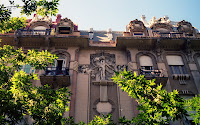
Wandering round the streets reveals other less fantastic but still fabulous buildings, with wonderful details.


But nothing prepared me for turning a corner and coming across this. Those nymphs must be at least three metres tall, and the putti above the size of a grown human. They look like marble, and could well be, but are more likely to be stucco, perhaps mixed with with marble dust. I can't help wondering who chose to sit on that balcony between those nymphs for a morning coffee. & in that quiet, tree-lined side street it would still be exceptional.

& the disadvantages of Congreso? The endless political demonstrations, noisy with drums and shouting, the streets closed off, and riot police, backed up by water cannon. Not that I ever saw them do anything.The Confitería El Molino is one of the most extravagant – and decayed – buildings in the district. Completed a decade or so after the Congreso, it became a favourite meeting place for local cultural, business and political figures. The café was closed in 1997, and today is only rarely opened to the public except for events advertising the urgent need to restore the building. Derelict and boarded up, it appears to be falling apart. The more strange because it is just across the road from the Congress building itself, a great contrast of styles, the well-maintained austere American/Hellenic Capitol/Congress commanding serious respect, with the almost wilfully bizarre Molino, which almost urges you not to take it seriously, a fun building. I think Tangocherie wrote about it and the well-used dance floor there, but I can't find the reference.


(Just a note here: the UK has an ornate Parliament building as its predecessor burned down during a short period when Gothic was fashionable. A few years earlier or later, and our Parliament would have been a serious block of Portland stone.)
Wandering round the streets reveals other less fantastic but still fabulous buildings, with wonderful details.


But nothing prepared me for turning a corner and coming across this. Those nymphs must be at least three metres tall, and the putti above the size of a grown human. They look like marble, and could well be, but are more likely to be stucco, perhaps mixed with with marble dust. I can't help wondering who chose to sit on that balcony between those nymphs for a morning coffee. & in that quiet, tree-lined side street it would still be exceptional.
Wednesday, 15 February 2012
On being a tango commuter 2
It was mainly because I moved out of London, but it was also an accident of timing. In the early 2000s Ricardo Vidort and possibly Gavito taught regularly in London. I was lucky enough to come across what was probably Ricardo's last class ever in London soon after I started. I say 'come across' because I'd no idea who he was; I turned up that evening quite by chance. Later I realised what a wonderful chance it was, such a relief after miserable classes spent in a futile attempt to master Pablo Veron's choreography, wondering where the music had gone to. & it was Ricardo who said 'Hold your partner close!' That one class gave me a glimpse of the kind of energy and life, the sheer enthusiasm and happiness tango was, or could be. No wonder I was dissatisfied with London tango as I was encountering it.
Six months or so later, when YouTube got going, I found another name, or pair of names, Tete and Silvia. You mean BsAs tango isn't a salida, then an ocho, then a giro, then an ocho cortado, then a cross? It all runs together in one impulse, one energetic movement that relates so closely to the phrases of the music? That's what I want! I watched Ney Melo's videos over and over, open-mouthed. Thank you so much, Ney! No one taught that, let alone danced it, in London! From YouTube I began to realise that Tete and Silvia taught all over Europe, but never in the UK: since I could never find advance dates for their Europe tours I decided I had to go to Buenos Aires and hope they were there. I knew by then that Ricardo Vidort had died, so I went to meet Tete and Silvia. & they were there. More enthusiasm and happiness, and the moving presence of a couple who loved nothing more than dancing together. & of course there were others too who danced the tango of Buenos Aires.
So when I'm asked what I think of the European 'festivalitos' I have to say I really don't know. (Why 'festivalito' by the way? Why the diminutive? They aren't small, are they? & I think 'fiesta' would be the usual Spanish; doesn't 'European Tango Fiestas' sound much better?) On my first trip to BsAs over four years ago, I couldn't understand or communicate a lot, but I could get by. I didn't get many dances at first, but I was usually very satisfied with what I got. So for four years, during which time the 'festivalito' movement has grown so wonderfully in Europe, my tango thoughts have been elsewhere. & I think the teaching of close embrace social tango in the UK has generally got itself together during that time. Not that I've paid much attention to it I'm sorry to say; I've usually got plenty enough memories from a dozen or so classes stacked up in my mind to keep me occupied between yearly visits. (I call them 'classes' but for the most part they are practica sessions with portena dancers with long experience of the milongas, whose feedback and advice is incredibly valuable.)
It's as if there was a gap in London teaching between the early 2000s and 2010, give or take a few years. Dancing close embrace when I started seemed something of an endeavour: perhaps it would have been in 2000 too, but at least at that time there were sometimes teachers who encouraged it. & if you want to dance close now it's not hard to find people who can help and support and encourage you. This blog, and others, partly grew out of trying to make sense of and communicate what we were trying to dance at that time. It seemed all very new, and it took a while to find teachers who could help make sense of it.
I do look forward to taking part in a 'festivalito'... the diminutive is really irritating! Start again: I look forward to taking part in a great tango fiesta! I'm sure there's good dancing, but I know I'll always want to go back to Buenos Aires while it's still possible to sit in wonderful milongas and watch and meet dancers with over 60 years of tango behind them, and I'll probably still want to go there after they've gone, too. I'd urge everyone to think of taking the plunge while those older dancers are still there and on the floor; it's something else altogether. & I have to say, as a city it does start to get under your skin, resist it as you might.
Six months or so later, when YouTube got going, I found another name, or pair of names, Tete and Silvia. You mean BsAs tango isn't a salida, then an ocho, then a giro, then an ocho cortado, then a cross? It all runs together in one impulse, one energetic movement that relates so closely to the phrases of the music? That's what I want! I watched Ney Melo's videos over and over, open-mouthed. Thank you so much, Ney! No one taught that, let alone danced it, in London! From YouTube I began to realise that Tete and Silvia taught all over Europe, but never in the UK: since I could never find advance dates for their Europe tours I decided I had to go to Buenos Aires and hope they were there. I knew by then that Ricardo Vidort had died, so I went to meet Tete and Silvia. & they were there. More enthusiasm and happiness, and the moving presence of a couple who loved nothing more than dancing together. & of course there were others too who danced the tango of Buenos Aires.
So when I'm asked what I think of the European 'festivalitos' I have to say I really don't know. (Why 'festivalito' by the way? Why the diminutive? They aren't small, are they? & I think 'fiesta' would be the usual Spanish; doesn't 'European Tango Fiestas' sound much better?) On my first trip to BsAs over four years ago, I couldn't understand or communicate a lot, but I could get by. I didn't get many dances at first, but I was usually very satisfied with what I got. So for four years, during which time the 'festivalito' movement has grown so wonderfully in Europe, my tango thoughts have been elsewhere. & I think the teaching of close embrace social tango in the UK has generally got itself together during that time. Not that I've paid much attention to it I'm sorry to say; I've usually got plenty enough memories from a dozen or so classes stacked up in my mind to keep me occupied between yearly visits. (I call them 'classes' but for the most part they are practica sessions with portena dancers with long experience of the milongas, whose feedback and advice is incredibly valuable.)
It's as if there was a gap in London teaching between the early 2000s and 2010, give or take a few years. Dancing close embrace when I started seemed something of an endeavour: perhaps it would have been in 2000 too, but at least at that time there were sometimes teachers who encouraged it. & if you want to dance close now it's not hard to find people who can help and support and encourage you. This blog, and others, partly grew out of trying to make sense of and communicate what we were trying to dance at that time. It seemed all very new, and it took a while to find teachers who could help make sense of it.
I do look forward to taking part in a 'festivalito'... the diminutive is really irritating! Start again: I look forward to taking part in a great tango fiesta! I'm sure there's good dancing, but I know I'll always want to go back to Buenos Aires while it's still possible to sit in wonderful milongas and watch and meet dancers with over 60 years of tango behind them, and I'll probably still want to go there after they've gone, too. I'd urge everyone to think of taking the plunge while those older dancers are still there and on the floor; it's something else altogether. & I have to say, as a city it does start to get under your skin, resist it as you might.
Saturday, 14 January 2012
Milonga watching 2
A quick note: I'm simply trying to describe as accurately as I can my impressions of BsAs milongas. I don't intend any of this as a criticism of London or any other milongas. & perhaps the best way to describe the (few) Buenos Aires milongas I've enjoyed is to say that they are socially laid-back and slightly formal. The dancing, and the brief conversations between tangos, are the focus. I guess that public dances always used to be a bit formal, and something of that spirit persists.
When you first arrive at (say) El Beso and start watching the dance, the quality of it seems overwhelming. It's excellent; these are all people who've danced a lot. But after watching for a while the eye begins to filter out the dancers. Not all the older tangueros are marvellous, some of them could be relative beginners, but those whose tango ancestry goes back to childhood begin to stand out. They are both energetic and relaxed, easy and sure of themselves, they have nothing to prove. They are all different, of course. Pedro keeps his feet busy without doing anything that looks particularly complicated, although he's totally assured, but he expresses the music with his upper body: partners who've danced with him tell me that there's a constant flow of emotion from his upper body. Another older guy dances with a smile: perhaps there's an element of wit in his dance as his partners laugh for no apparent reason other than that his feet might have led them somewhere unexpected. Another leads effortlessly a range of movement that always looks fresh and new. Alberto Dassieu leads a dance with a lot of style, and uses pauses and changes of speed, as well as a lot of upper-body movement. & so on, there are others. They are individual. & everyone from that background can effortlessly and comfortably fit plenty of dance into the tightest of spaces as a matter of course, where I'm challenged to keep moving at all.
Beyond this handful of giants, you start to notice a younger generation, late twenties onwards I suppose. They are fluent and move well, with good posture, which is initially impressive, but then perhaps you start to notice they repeat much the same dance in the same way, tanda after tanda, to different orquestas, and perhaps it's a bit breathless, a bit tense. I start to get the impression that many of the younger dancers are following patterns of steps they've learned: I start to recognise sequences of steps strung together, the salida, the giro, which I don't notice so much with the older dancers. Perhaps the older dancers think of their dance step by step, rather than in sequences of steps; this may be the secret of keeping moving in a confined space. & the dance of the younger generation is a lot less individual: they look much more alike.
Some younger dancers have mastered whole styles: I do a continuous double-take at 'Los Gavitos'. They do the master's dance really well, left and right hands raised high, the guy's left wrist twisted over, and their dance is very accomplished, but it's on the edge of looking like parody: it's not quite theirs, it doesn't have the instinctive naturalness of the tango of the older generation. Other younger dancers seem too fluent for their own good: the leaders can fit in eight consecutive giros, so they do, whether it seems to suit the music or not (perhaps whether their partner likes it or not). And of course there are a few younger dancers who look just great, and you can't help feeling that their emotional response to the music, excellent posture, relaxed physicality, and easy spontaneous movement will just continue to look better and better.
All that, of course, is how you think when you look at it from the outside. What really sticks, what really matters, is how relaxed, warm and affectionate milongas can feel. I'm probably naïve in finding it utterly entrancing to experience tango like that: perhaps there are layers of competitiveness, aggression and duplicity there that I don't notice, but I'd like to doubt it.
Pina Bausch told her dancers 'Dance for love!' What better reason, what other reason, can there be to dance tango?
When you first arrive at (say) El Beso and start watching the dance, the quality of it seems overwhelming. It's excellent; these are all people who've danced a lot. But after watching for a while the eye begins to filter out the dancers. Not all the older tangueros are marvellous, some of them could be relative beginners, but those whose tango ancestry goes back to childhood begin to stand out. They are both energetic and relaxed, easy and sure of themselves, they have nothing to prove. They are all different, of course. Pedro keeps his feet busy without doing anything that looks particularly complicated, although he's totally assured, but he expresses the music with his upper body: partners who've danced with him tell me that there's a constant flow of emotion from his upper body. Another older guy dances with a smile: perhaps there's an element of wit in his dance as his partners laugh for no apparent reason other than that his feet might have led them somewhere unexpected. Another leads effortlessly a range of movement that always looks fresh and new. Alberto Dassieu leads a dance with a lot of style, and uses pauses and changes of speed, as well as a lot of upper-body movement. & so on, there are others. They are individual. & everyone from that background can effortlessly and comfortably fit plenty of dance into the tightest of spaces as a matter of course, where I'm challenged to keep moving at all.
Beyond this handful of giants, you start to notice a younger generation, late twenties onwards I suppose. They are fluent and move well, with good posture, which is initially impressive, but then perhaps you start to notice they repeat much the same dance in the same way, tanda after tanda, to different orquestas, and perhaps it's a bit breathless, a bit tense. I start to get the impression that many of the younger dancers are following patterns of steps they've learned: I start to recognise sequences of steps strung together, the salida, the giro, which I don't notice so much with the older dancers. Perhaps the older dancers think of their dance step by step, rather than in sequences of steps; this may be the secret of keeping moving in a confined space. & the dance of the younger generation is a lot less individual: they look much more alike.
Some younger dancers have mastered whole styles: I do a continuous double-take at 'Los Gavitos'. They do the master's dance really well, left and right hands raised high, the guy's left wrist twisted over, and their dance is very accomplished, but it's on the edge of looking like parody: it's not quite theirs, it doesn't have the instinctive naturalness of the tango of the older generation. Other younger dancers seem too fluent for their own good: the leaders can fit in eight consecutive giros, so they do, whether it seems to suit the music or not (perhaps whether their partner likes it or not). And of course there are a few younger dancers who look just great, and you can't help feeling that their emotional response to the music, excellent posture, relaxed physicality, and easy spontaneous movement will just continue to look better and better.
All that, of course, is how you think when you look at it from the outside. What really sticks, what really matters, is how relaxed, warm and affectionate milongas can feel. I'm probably naïve in finding it utterly entrancing to experience tango like that: perhaps there are layers of competitiveness, aggression and duplicity there that I don't notice, but I'd like to doubt it.
Pina Bausch told her dancers 'Dance for love!' What better reason, what other reason, can there be to dance tango?
Monday, 9 January 2012
Milonga watching 1
Some scattered observations and generalisations. A big one to start with: Buenos Aires milongas seem to be a lot cooler than the (few) London milongas I get to, but at the same time the dancing is a lot more emotionally intense. Isn't it true that in London – and probably in Europe – we go at milongas like there's no tomorrow? It's party time! Dance till you drop! We – or at any rate a lot of dancers; it's as if we want to dance every dance and then some more. The festivals give us the chance to dance practically non-stop all weekend. Our enthusiasm is marvellous.
Buenos Aires milongas feel more like places where people hang out, sit around with a drink, whether a glass of red wine or a shared bottle of champagne, maybe have supper with partners or friends, greet friends and chat, watch the dancing, dance for a while. I've seen Pedro, for instance, dance nearly every tanda for several hours, but on another evening he'll sit at the back, watch, chat with friends, dance maybe just one or two tandas. Milongas tend to last around six hours, some a bit longer, a few are shorter: six until midnight, ten until four am, and so on. People drop by for a few hours, maybe more, and there's an hour or two later on when everyone's on the floor. Milongas really feel like a way of life, a part of ordinary life rather than climactic weekly events, perhaps because they go on for a relatively long time and because there are a lot of them. I wonder if we'll start to use milongas like this in London in the years to come, as sort of a facility that's always around, rather than unique, striking events that you've got to make the most of while they last. It's an agreeably relaxed approach which I find I'm very comfortable with. So you sit and watch for a few hours, see a few friends and enjoy some dances. If you didn't get the dances you wanted, well, there's always tomorrow or next week.
At the same time the quality of dance can be really intense. The embrace can look (and feel) incredibly warm, affectionate, tender, even between total strangers. The strict form of the cabeceo probably helps here: for a lady, there's no way the guy you danced it with can follow you back to your table and try to chat you up. (However, cards with email addresses are passed around, and are really useful.) I think that emotional quality is quite rare in London dance, and I wonder if it's a consequence of the strict form of cabeceo. I can't help noticing that almost all the very intense dances I've had have been with partners who are from Buenos Aires, and I suspect that this is how they like, and expect, to dance with local guys. (You might dance a good part of a tanda before you find where your partner is from, so it's not just imagination.) Dances I've had with other visitors tend to feel slightly more casual, impersonal, by comparison.
I've never been really certain what they mean when they say 'Tango is a feeling' but I imagine it might well be a feeling of an intense tenderness. Perhaps it's 'entrega', the feeling of losing yourself in another person, as if the sense of ego vanishes into the music, the movement, the partner, the floor.
Buenos Aires milongas feel more like places where people hang out, sit around with a drink, whether a glass of red wine or a shared bottle of champagne, maybe have supper with partners or friends, greet friends and chat, watch the dancing, dance for a while. I've seen Pedro, for instance, dance nearly every tanda for several hours, but on another evening he'll sit at the back, watch, chat with friends, dance maybe just one or two tandas. Milongas tend to last around six hours, some a bit longer, a few are shorter: six until midnight, ten until four am, and so on. People drop by for a few hours, maybe more, and there's an hour or two later on when everyone's on the floor. Milongas really feel like a way of life, a part of ordinary life rather than climactic weekly events, perhaps because they go on for a relatively long time and because there are a lot of them. I wonder if we'll start to use milongas like this in London in the years to come, as sort of a facility that's always around, rather than unique, striking events that you've got to make the most of while they last. It's an agreeably relaxed approach which I find I'm very comfortable with. So you sit and watch for a few hours, see a few friends and enjoy some dances. If you didn't get the dances you wanted, well, there's always tomorrow or next week.
At the same time the quality of dance can be really intense. The embrace can look (and feel) incredibly warm, affectionate, tender, even between total strangers. The strict form of the cabeceo probably helps here: for a lady, there's no way the guy you danced it with can follow you back to your table and try to chat you up. (However, cards with email addresses are passed around, and are really useful.) I think that emotional quality is quite rare in London dance, and I wonder if it's a consequence of the strict form of cabeceo. I can't help noticing that almost all the very intense dances I've had have been with partners who are from Buenos Aires, and I suspect that this is how they like, and expect, to dance with local guys. (You might dance a good part of a tanda before you find where your partner is from, so it's not just imagination.) Dances I've had with other visitors tend to feel slightly more casual, impersonal, by comparison.
I've never been really certain what they mean when they say 'Tango is a feeling' but I imagine it might well be a feeling of an intense tenderness. Perhaps it's 'entrega', the feeling of losing yourself in another person, as if the sense of ego vanishes into the music, the movement, the partner, the floor.
Wednesday, 28 December 2011
Tango stories 3
I recently watched Ricardo Suarez dance milonga with Enriqueta Kleinman. I've watched him before, but now I'm mesmerised by how precisely he steps to the beat. I follow his feet; his steps are small and unostentatious, but effortless and absolutely precise. When my eyes follow other dancers I get the impression that none of them is quite so continuously exact, and some of the most experienced dancers in Buenos Aires are on the floor. Later I mention this to Enriqueta, and she laughs out loud.
'Ricardo! He's so amazing. He's incredibly precise, isn't he? & you know how old he is? 87! & he still works: he has a little store somewhere. He goes out dancing almost every night, and he's so popular he dances with all the best tangueras. & he doesn't even need glasses for the cabeceo! We women go for the older guys! The older the better!' & she laughs uproariously.
Momentarily I wonder if Tangocommuter can look forward to dancing with all the best tangueras in 30 or 40 years... but the wish dissolves pretty fast. She's not talking simply about older guys: she's talking about guys who for the most part grew up in families where everyone danced, and where tango meant so much that the kids would be outside practising, long ago. Sadly, not my background.
'The two things women appreciate above all else in a leader' continues Enriqueta, 'are the clarity of the 'marca' (lead), and a 'marca' that seems to be a part of the music.'
PS: Here's Ricardo dancing Tango Negro in Cachirulo earlier this year (sadly with wrong aspect ratio: he's thin but not that thin!). & Irene and Man Yung posted recently about Ricardo, with a video.
PPS: Here's the Practimilonguero video of Ricardo Suárez, interviewed by and dancing milonga with Mónica Paz.
'Ricardo! He's so amazing. He's incredibly precise, isn't he? & you know how old he is? 87! & he still works: he has a little store somewhere. He goes out dancing almost every night, and he's so popular he dances with all the best tangueras. & he doesn't even need glasses for the cabeceo! We women go for the older guys! The older the better!' & she laughs uproariously.
Momentarily I wonder if Tangocommuter can look forward to dancing with all the best tangueras in 30 or 40 years... but the wish dissolves pretty fast. She's not talking simply about older guys: she's talking about guys who for the most part grew up in families where everyone danced, and where tango meant so much that the kids would be outside practising, long ago. Sadly, not my background.
'The two things women appreciate above all else in a leader' continues Enriqueta, 'are the clarity of the 'marca' (lead), and a 'marca' that seems to be a part of the music.'
PS: Here's Ricardo dancing Tango Negro in Cachirulo earlier this year (sadly with wrong aspect ratio: he's thin but not that thin!). & Irene and Man Yung posted recently about Ricardo, with a video.
PPS: Here's the Practimilonguero video of Ricardo Suárez, interviewed by and dancing milonga with Mónica Paz.
Monday, 26 December 2011
29 in the shade with a fresh breeze...

Buenos Aires earlier this month.
Coming out of the hot subway into blazing midsummer sunshine to see... snowflakes adorning the front of the Abasto shopping mall. Bizarre!
Immigration from Europe to Argentina is starting up again, according to the Guardian. From Portugal to Brazil it's been a flood. There seems to be work in Argentina for young graduates from Spain and Italy in particular, where there's none in Europe. & on the streets I see many notices in restaurants and shop windows advertising work. I run into a young Italian woman who's in BsAs on holiday and looking for work: she'll be moving over next year. The climate is good, and the people welcoming. Argentina's history centres around welcoming immigrants and helping them to settle. Of course it's not immigration in the old, permanent sense, but as ever it's people going where the jobs are.
Friday, 23 December 2011
Tango stories 2
Enriqueta Kleinman tells me she went to a milonga in London. It'll remain nameless because she's not sure which night it was, but she says it was in a kind of side street or alley.
'You know, I've travelled regularly in the US and Europe, and I know cabeceo isn't practiced that much outside Buenos Aires, so I know what to expect. But a guy came up to me and just pointed to me and the floor! I couldn't believe it. Like I was his cow to be pushed around! He couldn't even say please!'
This is bad, this is very bad. It's uncivil and uncivilised. It's plain rude, it's really bad manners. It's shameful. It's definitely not cool. If you say 'please' you are in a sense begging, and accepting that you can be refused, although it's still hardly fair as you know that by being polite you are making it harder for a partner to refuse you. Perhaps it wouldn't matter too much if the dance was jive, without a lot of body contact, but tango is different.
Cabeceo is simple enough. A girl looks at you, or you catch her eye. You nod. If she nods back you go over and invite her onto the floor. If she doesn't nod back you look elsewhere. What's difficult about that? But ladies have to be part of it. If you spend all evening chatting with your friends, you might find yourself complaining next morning that you didn't get any dances. If you want to dance, it helps if you keep your eyes on and around the dance floor. Fact is, there are frequently more women than men, so I guess that refusing dances might might feel wrong, but if a guy finds he's regularly refused he's going to try and improve, or get out, so it's win-win.
I didn't think of asking Enriqueta how she responded to the boorish Englishman. (English? Surely not! Must have been a visitor...) But I know her slightly, and I know her English is good, so it's quite possible that a shamefaced would-be dancer sneaked out of a milonga that night. I hope so.
'You know, I've travelled regularly in the US and Europe, and I know cabeceo isn't practiced that much outside Buenos Aires, so I know what to expect. But a guy came up to me and just pointed to me and the floor! I couldn't believe it. Like I was his cow to be pushed around! He couldn't even say please!'
This is bad, this is very bad. It's uncivil and uncivilised. It's plain rude, it's really bad manners. It's shameful. It's definitely not cool. If you say 'please' you are in a sense begging, and accepting that you can be refused, although it's still hardly fair as you know that by being polite you are making it harder for a partner to refuse you. Perhaps it wouldn't matter too much if the dance was jive, without a lot of body contact, but tango is different.
Cabeceo is simple enough. A girl looks at you, or you catch her eye. You nod. If she nods back you go over and invite her onto the floor. If she doesn't nod back you look elsewhere. What's difficult about that? But ladies have to be part of it. If you spend all evening chatting with your friends, you might find yourself complaining next morning that you didn't get any dances. If you want to dance, it helps if you keep your eyes on and around the dance floor. Fact is, there are frequently more women than men, so I guess that refusing dances might might feel wrong, but if a guy finds he's regularly refused he's going to try and improve, or get out, so it's win-win.
I didn't think of asking Enriqueta how she responded to the boorish Englishman. (English? Surely not! Must have been a visitor...) But I know her slightly, and I know her English is good, so it's quite possible that a shamefaced would-be dancer sneaked out of a milonga that night. I hope so.
Tuesday, 20 December 2011
Distant music

I find this image fascinating. It's on Todotango here and I don't have permission to use it. I'll have to remove it if this is a problem with Todotango. I hope not.
The recording horn and the recording lens face each other across a small wooden room. The dark funnel of the recording horn is the focus, the central point. Down it the music will vanish to reappear now, or at any other point in time when we desire to listen to it. The image has disappeared into the unseen lens of a dark camera, invisibly onto film or a glass plate to be made visible chemically, and to reappear now and in the future. Another kind of record, a written score, is on the piano.
The horn dominates the layout. Some serious carpentry has gone into ensuring that the musicians are at the right height from the floor, and in the right place, for optimum balance of sound. Perhaps the producer would have run sound checks, listening through the horn (which appears to lead through a wood panel into an adjacent room) to get the right balance of sound. Three violins; two stand on little platforms and one on the floor, a little further from the horn. The fourth person at the middle of the central group and closest to the horn is probably the singer, although he could be holding, but not playing, a flute. Dominating the image, on the right, is Roberto Firpo at the piano, his left arm a strong diagonal into the central group of musicians. He's the leader, but I assume he's higher than the other musicians because the sound balance requires it, the back of the piano to the horn. Two bandoneons, perched on chairs with little footstools, complete the orquesta. The layout is neat and well-organised.
Presumably it's a small wood-panelled room, the photographer in the doorway, holding a magnesium flash at arm's length in his left hand. The other three sides of the room (there doesn't appear to be a corner behind the musicians) would help to retain and focus the sound into the horn. The horn means the date is probably pre-1928, when electrical recording became available. After that date there would be a familiar microphone on a stand, but the musicians would still have been arranged in relation to it for balance of sound.
It's odd and wonderful, this image of musicians at work, not only because this technology is so distant now. It's a photo of the musicians but it's also a photo of a process, the process of making a record, then a recent technology and industry. It's odd because it's relatively informal, in an age when photographs tended to be a formal record. You'd expect musicians to want to be seen in suits and bow ties on the bandstand. Here, instead, they seem proud to be seen at work in the recording studio, tieless, shirt sleeves rolled up, but looking clean and neat nevertheless, trousers neatly pressed, the gloss of brilliantined hair clearly visible.
Photo and film of the process of recording sound, two recording technologies together, have stayed with us. An obvious example is Jean Luc Godard's 1+1, a film of how the Rolling Stones developed and recorded Sympathy for the Devil, starting with just the words and an outline melody. The recording studio is immediately recognisable, with booths and baffles, microphones and cables everywhere.
The sound from Firpo's recording would have been relatively imperfect, but the image makes me want to know more: where was the studio, how did the musicians get there, what was the weather like? A day in Buenos Aires long ago, a tango recorded, and some sweet, slightly distant music we can still hear.
PS. I keep looking at the third violin, the one standing nearest the piano, who looks familiar. I wonder if it's Julio de Caro. I think he played with Firpo briefly in 1917; he would have been 17 or 18. Later he established his own orquesta.
Sunday, 18 December 2011
Tango stories 1
I can sit and watch the dancing in El Beso all night if I have to. I'm on the floor if I can be, but I'm under no illusions: no way can I lead like these guys. I can see what their partners expect, and I know I'm less than inferior by comparison. But I can sit happily all night and watch.
I've seen breathtaking fast complex phrases that are so clear and casually executed, that fit so neatly into the space, and also exist as part of the music. And simple things too, but things that are far too difficult to remember clearly, let alone to describe in words. If you want to see the best tango, and to be thoroughly humbled, as a leader, that is, sit in El Beso for a few hours.
But there's one thing I remember that I can describe: it'll have to stand for all the things I can't quite remember and could never describe. The tango had started to play but, as usual, the couples were still standing around chatting. When suddenly a couple emerges, just walking, step by step, walking, walking right round the room, casually threading it's way between the standing, talking couples. Kind of just walking but it was elegant, it looked wonderful, so it was a dance too. It was breathtaking in simplicity because it was only walking, a few pauses but no weight changes, no shifts from parallel to cross, it simply made a dance out of strolling round standing couples. How amazing is that? Pedro Sanchez and a partner. As he would say (in English): 'Beautiful!'
I've seen breathtaking fast complex phrases that are so clear and casually executed, that fit so neatly into the space, and also exist as part of the music. And simple things too, but things that are far too difficult to remember clearly, let alone to describe in words. If you want to see the best tango, and to be thoroughly humbled, as a leader, that is, sit in El Beso for a few hours.
But there's one thing I remember that I can describe: it'll have to stand for all the things I can't quite remember and could never describe. The tango had started to play but, as usual, the couples were still standing around chatting. When suddenly a couple emerges, just walking, step by step, walking, walking right round the room, casually threading it's way between the standing, talking couples. Kind of just walking but it was elegant, it looked wonderful, so it was a dance too. It was breathtaking in simplicity because it was only walking, a few pauses but no weight changes, no shifts from parallel to cross, it simply made a dance out of strolling round standing couples. How amazing is that? Pedro Sanchez and a partner. As he would say (in English): 'Beautiful!'
Saturday, 3 December 2011
December 3 2001
An article on the BBC website reminds that this was the day the Argentine banks, faced with a run, were closed down, allowing only a limited daily withdrawal. The peso was unlinked from the dollar, and inflation soared. The writer had been on the point of buying a flat, and when she got access to her money again it was worth only enough to buy a car. Someone else had dollars, and was able to pay off a mortgage because of an excellent exchange rate... There's been talk of an 'r' word – 'run' – by European economists recently. Of course it was a close call with Northern Rock a few years back, although economists also think of it in terms of the flow of money in and out of central banks.
Perhaps this is one of the reasons for the flourishing and well-organised short-let business in Buenos Aires. If you have money and don't trust the banks, you buy property and rent it. & I've been told that when you buy property it's usually cash: you have to turn up with a suitcase full of notes, adding another nerve-wracking twist to an already fraught business.
It's interesting to look out on a prospering South American city ten years later, with a largely untroubled cheerful surface, at ease with itself and doing well. Being an immigrant, like being a refugee, means having to cope without a safety net. It means self-reliance, taking nothing for granted, not having time for self-pity. Perhaps Argentina was well-equipped to survive and bounce back, and feels good about itself for doing so.
Tangoandchaos has a graphic account of Buenos Aires from December 3 2001 and the following weeks.
Perhaps this is one of the reasons for the flourishing and well-organised short-let business in Buenos Aires. If you have money and don't trust the banks, you buy property and rent it. & I've been told that when you buy property it's usually cash: you have to turn up with a suitcase full of notes, adding another nerve-wracking twist to an already fraught business.
It's interesting to look out on a prospering South American city ten years later, with a largely untroubled cheerful surface, at ease with itself and doing well. Being an immigrant, like being a refugee, means having to cope without a safety net. It means self-reliance, taking nothing for granted, not having time for self-pity. Perhaps Argentina was well-equipped to survive and bounce back, and feels good about itself for doing so.
Tangoandchaos has a graphic account of Buenos Aires from December 3 2001 and the following weeks.
Saturday, 29 October 2011
Areas of darkness
So a few of the most notorious of Argentine murderers have finally been found guilty, more than thirty years after their crimes. (BBC)
The dark past is only slowly receding. A recent story in a UK newspaper: police burst in on an Argentine man in his early 30s in Buenos Aires. They had come to take his DNA. Not that he was suspected of anything criminal, but he had been adopted in the late 1970s, and the Argentine state now has power to take DNA to establish the real identity of anyone adopted during 'the Process'. His worst fears were confirmed: his parents had been murdered in the ESMA centre after his birth there, and he had been adopted, to be brought up in a true Christian and catholic tradition, rather than the socialist tradition of his birth parents. (Irony wasn't a stong point of the military.) He was told his birth name, but he's currently going through the courts to be allowed to retain his adopted name as he believes his adoptive parents acted in good faith. Adoption can be difficult in the best of circumstances, and these must be the worst.
I read this story about the same time as Tangocherie posted about Dark Tangos by American author Lewis Shiner. He's made it available for free (link on Tangocherie). (In fact he's made all his novels available for free: I wonder what his publishers think of that.) I was immediately gripped when I read his description of a demonstration over the 'disappearance' of Jorge López just hours before he was due to give his final testimony against a former police chief accused of running one of the detention centres. This must have happened about a year before my first visit to the city. I heard the story of López when I took the tour of the ESMA centre in 2008. I was shocked: I thought people 'disappearing' was all in the past. Later, I found everywhere a little spray graffiti, a blank facial area beneath a cloth cap: López, a bricklayer by trade, had worn such a cap. Like other old political graffiti it's a simple and haunting image.
ESMA, where around 5,000 people were killed, is now one of the centres for researching and remembering every last detail of what took place during the 'dirty war' in the hope that, by remembering, such events can never recur. We were also told that no one from the armed forces has ever broken ranks to testify in court. The will and the money are still there to intimidate witnesses – and to make them disappear.
It's a reminder that despite the very normal appearance of the city and the wonderful milongas, just below the surface there are areas of darkness. Many people suffered terrible loss, and if you've been there you might well have danced with them. I believe that only a few of the oppressors – among them torturers and murderers – have ever appeared in court: the human rights movement has identified them, but they remain free, if now ageing. Unlikely, but you might have met them too, or passed by them in the streets.
The dark past is only slowly receding. A recent story in a UK newspaper: police burst in on an Argentine man in his early 30s in Buenos Aires. They had come to take his DNA. Not that he was suspected of anything criminal, but he had been adopted in the late 1970s, and the Argentine state now has power to take DNA to establish the real identity of anyone adopted during 'the Process'. His worst fears were confirmed: his parents had been murdered in the ESMA centre after his birth there, and he had been adopted, to be brought up in a true Christian and catholic tradition, rather than the socialist tradition of his birth parents. (Irony wasn't a stong point of the military.) He was told his birth name, but he's currently going through the courts to be allowed to retain his adopted name as he believes his adoptive parents acted in good faith. Adoption can be difficult in the best of circumstances, and these must be the worst.
I read this story about the same time as Tangocherie posted about Dark Tangos by American author Lewis Shiner. He's made it available for free (link on Tangocherie). (In fact he's made all his novels available for free: I wonder what his publishers think of that.) I was immediately gripped when I read his description of a demonstration over the 'disappearance' of Jorge López just hours before he was due to give his final testimony against a former police chief accused of running one of the detention centres. This must have happened about a year before my first visit to the city. I heard the story of López when I took the tour of the ESMA centre in 2008. I was shocked: I thought people 'disappearing' was all in the past. Later, I found everywhere a little spray graffiti, a blank facial area beneath a cloth cap: López, a bricklayer by trade, had worn such a cap. Like other old political graffiti it's a simple and haunting image.
ESMA, where around 5,000 people were killed, is now one of the centres for researching and remembering every last detail of what took place during the 'dirty war' in the hope that, by remembering, such events can never recur. We were also told that no one from the armed forces has ever broken ranks to testify in court. The will and the money are still there to intimidate witnesses – and to make them disappear.
It's a reminder that despite the very normal appearance of the city and the wonderful milongas, just below the surface there are areas of darkness. Many people suffered terrible loss, and if you've been there you might well have danced with them. I believe that only a few of the oppressors – among them torturers and murderers – have ever appeared in court: the human rights movement has identified them, but they remain free, if now ageing. Unlikely, but you might have met them too, or passed by them in the streets.
Wednesday, 12 October 2011
Un montón de milongas
I was just about to post this when I noticed Elizabeth's posting.
There's a huge cache of clips, about an hour of film, of BsAs milongas on Muller Patricia's YouTube channel, posted five months ago and labelled as 'Viejos Milongueros'. Apparently they date back to the 90s. I dashed in, hoping to find Ricardo Vidort, Muma, Portalea, Gavito, Tete, Elba Biscay... and was sadly disappointed. They show BsAs milongas all right, but the dance is the dance of people who enjoy social tango, although from what little I've seen perhaps it's not the tango of Lo de Celia or El Beso, or of what I think of as the 'old milongueros'. However, every now and again a couple slips past the camera with such easy grace that you think, 'Who was that?' Lively, good-natured social milongas – and good lighting too!
If anyone watches Osvaldo Natucci on Practimilongueros, be warned: there's a slight mistranslation. He divides dancers into artisans and aficionados, but the subtitles translate 'aficionados' as 'amateurs', which is misleading as it can suggest people who aren't very good at something. I think he'd call dancers like the social dancers in Muller Patricia's clips 'aficionados', rather than artisans, who are a bit more obsessive about their dance.
If anyone watches through all that film and comes across any of the 'greats', do let me know. I recognise one venue, La Ideal, and possibly one or two others, but I think there's film from several more. Patricia asks for any information anyone might have about the milongas and the people.
There's a huge cache of clips, about an hour of film, of BsAs milongas on Muller Patricia's YouTube channel, posted five months ago and labelled as 'Viejos Milongueros'. Apparently they date back to the 90s. I dashed in, hoping to find Ricardo Vidort, Muma, Portalea, Gavito, Tete, Elba Biscay... and was sadly disappointed. They show BsAs milongas all right, but the dance is the dance of people who enjoy social tango, although from what little I've seen perhaps it's not the tango of Lo de Celia or El Beso, or of what I think of as the 'old milongueros'. However, every now and again a couple slips past the camera with such easy grace that you think, 'Who was that?' Lively, good-natured social milongas – and good lighting too!
If anyone watches Osvaldo Natucci on Practimilongueros, be warned: there's a slight mistranslation. He divides dancers into artisans and aficionados, but the subtitles translate 'aficionados' as 'amateurs', which is misleading as it can suggest people who aren't very good at something. I think he'd call dancers like the social dancers in Muller Patricia's clips 'aficionados', rather than artisans, who are a bit more obsessive about their dance.
If anyone watches through all that film and comes across any of the 'greats', do let me know. I recognise one venue, La Ideal, and possibly one or two others, but I think there's film from several more. Patricia asks for any information anyone might have about the milongas and the people.
Saturday, 3 September 2011
Some I made earlier
It's always bewildered me that my sense of direction is so bad in BsAs, as it's usually pretty good in the UK. It was while making these pictures that I realised why. The sun shines in the deep canyons of central BsAs only between 12 and 2 at this time of year (in fact, probably throughout the year). &, of course, it moves from right to left, and its high point is north, in line with the grid of the centre of the city. As Coleridge wrote:
'The sun now rose upon the Right
Out of the sea came he,
Still hid in mist and on the left
Went down into the sea.' (The Rime of the Ancient Mariner.)
To add to the confusion my street map shows the shoreline of the Río de la Plata at the bottom of the page, which I habitually read as south. All very confusing!
I'd normally avoid the midday sun when making pictures, but the light was very clear and luminous, so I couldn't resist. Since it was winter, even the midday sun didn't flatten out and bleach the pictures: moreover even at midday it still wasn't high in the sky, making dramatic shadows. I resolved to go out again for more the following day – but the clouds came over, and this wonderful light was never repeated.


'The sun now rose upon the Right
Out of the sea came he,
Still hid in mist and on the left
Went down into the sea.' (The Rime of the Ancient Mariner.)
To add to the confusion my street map shows the shoreline of the Río de la Plata at the bottom of the page, which I habitually read as south. All very confusing!
I'd normally avoid the midday sun when making pictures, but the light was very clear and luminous, so I couldn't resist. Since it was winter, even the midday sun didn't flatten out and bleach the pictures: moreover even at midday it still wasn't high in the sky, making dramatic shadows. I resolved to go out again for more the following day – but the clouds came over, and this wonderful light was never repeated.


Thursday, 1 September 2011
Another visitor
I run into a woman from Scandinavia I danced with a few times on my last visit. I'm surprised to see her again and wonder if she lives here now, but it turns out our visits have coincided. I remember she speaks surprisingly little English for a Scandinavian, but is fluent in Spanish, and I discover she's actually Latin American by birth, and grew up in Europe; part of the diaspora from the bad years, no doubt. Would she want to live here? Emphatically no: after over 40 years, she tells me, she considers herself European. & she asks if I live in BsAs since she finds me here again: emphatically no! If I lived here I'd be fluent in castellano, and I might even be a passable tanguero too. She's come here for just two weeks to dance a bit, and it's really sad to see how little she gets to dance. She's an excellent dancer and knows the music really well, but she's not young and attractive. She has a few friends here who enjoy dancing with her, but it's a real shame she doesn't get to spend more time on the floor.
Sunday, 28 August 2011
The city
The city's a struggle as ever, but I notice how it's being improved. There are new buses on the streets, new 'bendy buses' too. The 'subte' (underground) is being extended. Cycle lanes are being marked, and there's a bright yellow cycle hire system: maybe I just didn't notice this last time. I notice more vegetarian restaurants and take-aways too: apparently meat has got very expensive. Smartphones aren't as common here, but you do see them. The Teatro Colon, the huge opera house, has been renovated and is now back in use. & there seem to be more milongas than ever, and more people dancing.
When I first came here more than three years ago my impression was of a very run-down city, but it looks better now - or perhaps I'm just used to it. The pavements still need work, although I did see a pavement under repair. My impression is that there's a very extensive and reasonably well-off area of society that could be called 'middle class', perhaps not wealthy by European standards, but confident and self-assured. Shops are full of good-looking consumer goods. I've heard it said that Latin America in general has weathered the 'global' downturn much better than Europe and the US. I've heard that there's less personal debt here, and maybe the banks couldn't afford to scoop up 'toxic assets', or were just smart. It looks like a stable and reasonably prosperous capital city.
This trip was planned and carried out very fast. I wanted to return this year and it had to be summer or late October, then I found a good deal on a Lufthansa return flight which I couldn't resist, and six days later I was flying. Getting an apartment at such short notice wasn't so easy, but there was availability, and I took this one in Barrio Norte, a 12-minute walk into El Beso and the centre, and on the way out to Canning. The agency (Buenos Aires Travel Rent) were very helpful and got the deal sorted out fast. There's a good supermarket round the corner, with fresh vegetables and fruit too. The apartment is above an arcade and row of shops catering to the local goth/skateboard/tattoo community so there are usually some curiously-dressed kids around. The apartment is a bit more expensive than I'd like, but what the hell: I'm off to El Beso again tonight...
When I first came here more than three years ago my impression was of a very run-down city, but it looks better now - or perhaps I'm just used to it. The pavements still need work, although I did see a pavement under repair. My impression is that there's a very extensive and reasonably well-off area of society that could be called 'middle class', perhaps not wealthy by European standards, but confident and self-assured. Shops are full of good-looking consumer goods. I've heard it said that Latin America in general has weathered the 'global' downturn much better than Europe and the US. I've heard that there's less personal debt here, and maybe the banks couldn't afford to scoop up 'toxic assets', or were just smart. It looks like a stable and reasonably prosperous capital city.
This trip was planned and carried out very fast. I wanted to return this year and it had to be summer or late October, then I found a good deal on a Lufthansa return flight which I couldn't resist, and six days later I was flying. Getting an apartment at such short notice wasn't so easy, but there was availability, and I took this one in Barrio Norte, a 12-minute walk into El Beso and the centre, and on the way out to Canning. The agency (Buenos Aires Travel Rent) were very helpful and got the deal sorted out fast. There's a good supermarket round the corner, with fresh vegetables and fruit too. The apartment is above an arcade and row of shops catering to the local goth/skateboard/tattoo community so there are usually some curiously-dressed kids around. The apartment is a bit more expensive than I'd like, but what the hell: I'm off to El Beso again tonight...
Subscribe to:
Posts (Atom)